Bookstore Moving, Everything Else on Hold

Dave’s science fiction bookstore in Berkeley, The Other Change of Hobbit, is moving to a new location (at 3264 Adeline, two blocks south of the Ashby BART station and a couple doors down from The Vault restaurant). They’ve been in their current location for 17 years and have accumulated a ton of stuff that now has to be moved. Of course, being an independent bookstore nowadays, this all has to be done on a shoestring, but quite a few regular customers have pitched in and helped. I’ve been helping mostly with the setup in the new space, figuring out how to arrange the bookcases and bolting them to the walls and so on. I worked through the last two weekends on the move and I’ll probably work through this one, too.

The store is currently open just 5 pm to 7 pm. Four cases of new releases and eight cases of paperbacks are now stocked. The new store has twice the sales floor space but a small fraction of the storage space, and a lot of stuff that has been in boxes in the basement for years is going to be going out on the sales floor as we get more cases up. Our goal is to be open full days tomorrow and Sunday, and then a grand opening next weekend.

Meanwhile, I’ve been bushed. I’m starting on a new play, my first spoken play in quite a long time, and I’m eager to work on that but I’ve had very little time for it. After the move is over I may take a few days off work and focus on that. I’ve got an outline and good first drafts of scenes two and three and a part of scene one, which I’ve written in small chunks of time here and there, but that’s less than half the first act, and there will be three.

Ouch

Very frustrating. As of two weeks ago Berkeley Opera was working on a grant proposal to assist in the development and production of my next opera adaptation, The Golden Slipper. I was writing up a description of the work and stuff like that for use in the the application.

One week ago Berkeley Opera got a new artistic director. The former artistic director, Jonathan Khuner, is now just music director, and Mark Streshinsky is the new artistic director. I knew this was in the works, so it’s not a surprise. I only know Mark slightly but he’s a sharp guy.

However, suddenly the grant proposal is not happening and I am told that Berkeley Opera will not do The Golden Slipper, end of story. Huh?

Oh well. I didn’t start writing The Golden Slipper because Berkeley Opera wanted to do it, but because I wanted to write it, and the company’s interest came later. So nothing’s really changed. I’ll keep at it and finish it and if it’s good, it’ll get done somewhere all the same.

Search and You Will Find

According to the “blog stats” page on my blog, somebody came to this blog by searching on “girl of the golden west mother’s foot is on dads”. What an odd thing to be searching for.

Well, if they were by any chance looking for a ridiculously overlong blog entry obsessing in detail about that one particular line in that opera, then I imagine they found what they were looking for.

On Case Keepers

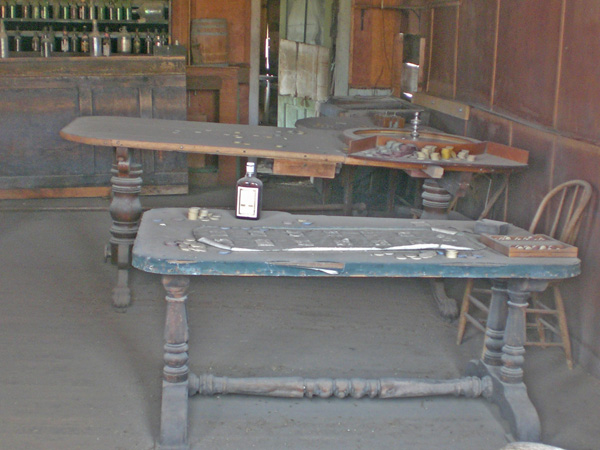
Faro table in saloon at ghost town of Bodie, CaliforniaThursday before last, Dave and I visited Bodie, an old mining town turned ghost town in the eastern Sierras. It’s a fascinating place, and I also accomplished a small personal goal there, which will take some explaining.

A couple years back, I wrote an adaptation of the Puccini opera The Girl of the Golden West, which is set in a Sierra mining camp in the first years of the Gold Rush. As far as I know, mine is the first and only English version that has anything like the right kind of language, that has the characters singing in the authentic American dialect for that time and place. There’s a faro game going on during much of the first act, and I wanted to get the actions and the table talk right, so I did some research into the rules and language of faro.

(As far as I can tell, by the way, the Italian libretto gets it all very wrong, as though the librettists just made up a lot of rules and terminology. Unless perhaps faro was played rather differently in Italy. Though even that would be only half an excuse, as the story takes place in the California Gold Rush, not in Italy.)

And it wasn’t just the table talk that depended on getting the rules of faro right. At a very important point in the first act, the central character, Minnie — the “Girl” of the title — reminisces about her childhood. Her parents ran a saloon, and she remembers her father running the faro game and her mother sitting at the table with him. The memory is important for understanding her character and her actions later in the play. Here she is in the original Belasco play:

And me, a kid as little as a kitten, under the table sneakin’ chips for candy. Talk about married life! That was a little heaven. I guess everybody’s got some remembrance of their mother tucked away. I always see mine at the faro table with her foot snuggled up to Dad’s an’ the light of lovin’ in her eyes. Ah, she was a lady!

So why was Minnie’s mother at the table? The Italian libretto assumes that she was one of the players:

Mother was lovely, she had pretty little feet:
Sometimes she played, too, and I,
hiding myself under the table
waiting to catch any coins that fell,
would see her secretly press my father’s foot —
They loved each other so much! Ah!

But that doesn’t make any sense. It would look — and in fact be — very improper for the part owner of the saloon to be a player in a gambling game being run by her own husband, the other part owner. At this point in the story, there has already been cheating at cards, and there will be more later on, and it’s a crucial point of Minnie’s character that she greatly admired her father for his honesty as a faro dealer. So the very last thing I want to do is have anyone in the audience thinking that the point of the anecdote is that Minnie’s mother and father were cheating by passing signals to each other under the table with their feet, and that Minnie was mistaken in thinking that her father was an honest man. (In fact, it would be pointless to try to cheat in this way at faro, because there’s no useful information you could communicate in this way. But the audience doesn’t know the rules of faro and won’t know this.)

As a secondary matter, I really hate the line in the Italian libretto about Mother’s pretty little feet. What on earth does the fact that her feet were small and pretty have to do with the point Minnie is trying to make with this anecdote? So I was hoping to find other, more worthwhile words to put on those notes.

In Belasco’s novelization of the play, Minnie says more:

“Why, mother tho’t so much o’ that man, she was so much heart an’ soul with ‘im that she learned to be the best case-keeper you ever saw. Many a sleeper she caught! You see, when she played, she was playin’ for the ol’ man.” She stopped as if overcome with emotion, and then added with great feeling: “I guess everybody’s got some remembrance o’ their mother tucked away. I always see mine at the faro table with her foot snuggled up to Dad’s, an’ the light o’ lovin’ in her eyes.”

The lines in the novel are loaded with character, and I knew I wanted to try to capture some of that flavor in my libretto. (The formal, literary language that the characters speak in the Italian libretto is breathtakingly wrong for this story, and why all the existing English translations I’ve seen emulate it is beyond me. It’s bad enough that it sounds ridiculous to American ears for characters in the Old West to be speaking formally correct English, but worse, the marked difference in background and education between Minnie and Dick is crucial to the story and crucial both to why they’re attracted to each other and to why they have trouble opening up to each other, and it ought to, needs to be reflected in how they speak, as it is in the play. If you’re not hearing that difference between them in every dialogue they have together, you’re not getting what is maybe the single most important thing about their relationship.)

But for all the color of the lines in the novel, the matter was still puzzling. What was it that her mother was doing to help at the table, exactly? I felt I needed to know in order to get Minnie’s reminiscence right.

With some reseach, I found the answer: An abacus-like device called a case keeper or case counter was used at the faro table to keep track of the cards that had been played. Usually the dealer “kept case” (kept track of the cards), but if the game was a busy one, the dealer might have an assistant, who was also called the case keeper, or sometimes the lookout. The lookout’s duties included keeping an eye out for sleepers, which were bets made that could no longer win because all four cards of the rank had already appeared; the dealer could claim those as his own if he — or his lookout — spotted them before the players who made those bets noticed them and took them back. Since the case keeper was on the table in full view of everyone, for a player to lose a sleeper wasn’t a matter of bad luck but of carelessless. As the game of faro is a fair one, with the odds giving no advantage to the dealer, spotting sleepers was the only way the dealer could make a profit from the game. I assume that a saloon would run a faro game primarily as a way of drawing in customers who would then buy drinks, and not so much as a way to make a profit from the game itself, but a lookout who was good at catching sleepers would have been an asset all the same.

So in my adaptation, I have Minnie sing:

Square, though — that was Father!
An’ when the game was busy,
Mother sat as the dealer’s lookout.
An’ underneath the table
I’d be keepin’ quiet,
hopin’ someone’d drop
coins on the floor.
An’ I’d see how her foot would snuggle
right up close to father’s.
Lord, they was happy! They was so happy!

It’s not much, only a line about “the dealer’s lookout”, but it’s right, right for Minnie’s character and right for the story, and even though I’d be lucky if one person in the audience had any idea what the dealer’s lookout did, the audience at least gets that her mother was there to help the dealer, not to play.

So now that I had learned so much about a nearly forgotten card game, I’ve wanted ever since to see an authentic faro table and case keeper with my own eyes. I’ve seen pictures, of course. And I’ve seen a faro table now in the Oakland Museum, but there wasn’t a case keeper with it.

Well, in the ghost town of Bodie, they’ve locked up the old buildings, but they’ve taken whatever furniture and other items were left behind when the town was abandoned, and they’ve arranged them in something like the layout they may have had, so that you can look in through the windows of the buildings and see them. And Bodie has one surviving saloon building, and sure enough, in the saloon is an old warped faro table, and on the faro table is an honest-to-god case keeper.

In my photo, the faro table is the nearer of the two tables (the one in back is a roulette table), and the case keeper is at the near right corner of the table.
Exercising No Restraint

This headline from a week ago inspired a round of limerick-writing on the WELL:

World’s strongest vagina breaks own record lifting 14 kilos

This was my contribution:

An athlete whose skills were prodigious
Lifted weights with her pubococcygeus.
When she went on a date,
Sex started out great
But it usually wound up litigious.

It’s hard to resist a legitimate opportunity to rhyme pubococcygeus. I’m not likely to have another.

Another Step Ahead

Finished another lyric for the work in prog. Good to feel like I’m moving forward again.

It was a tricky lyric to work out, partly because I have so much more I need to say here than the original librettist did. He just needed to say, “Here we are at this point in a story you all already know,” short and sweet. But I’m taking the well-known story and I’m telling it in terms of a very different time and place, a very different culture, so I have a couple of additional points I need to make, and I didn’t have quite enough notes for all the words I needed to use, not unless I made the lyric so dense with information that the points would rush by too quickly for the audience to assimilate them.

After trying out and rejecting a whole lot of other possibilities, I ended up adding repeats to two sections to give me sixteen more bars to set words on. Not my first choice; I would have preferred to use the number exactly in its original form. But my ear tells me the repeats will make decent musical sense. And anyway, this is such a free-wheeling adaptation that any Opera Purists who would be offended by such liberties with the composer’s intentions will already have stormed out of the theater in a huff well before we reach this point anyway. So what the heck.

Review in the SF Chron

Whew, what a weekend last weekend was. Terrific performances on Friday evening and Sunday afternoon, with a whole lot of friends in the audience on Friday and a few on Sunday as well. There were a few empty seats in the back rows on Friday, but Sunday was completely sold out and Dave and I had to stand in the back of the house to watch the show. (Believe me, I don’t mind.) Sunday’s audience gave us a standing ovation, and then during the bows the cast presented Ernest Knell (our musical director) and me with a lovely gift: copies of the poster of Stella in Don Giovanni that was onstage during the show, autographed by the whole cast and framed. Oh, man, that was very, very sweet.

Last Friday morning the San Francisco Chronicle review came out. On the whole a very, very good review, though with a few odd qualifications about my libretto:

The Berkeley Opera’s lively and affecting new production of Hoffmann touches those chords with deft precision. Treading a fine line between comedy and pathos, Wednesday’s performance at the Julia Morgan Center for the Arts combined first-rate musical values with a clear dramatic and verbal focus to produce a nimble portrait of artistic self-justification.

The verbal element was the province of wordsmith David Scott Marley, whose English adaptation of the text — a revision of a script first mounted in 1999 — brought forward the combination of exuberance and longing at the heart of Hoffmann. Compared with the manic inventiveness of some of Marley’s other stage creations — including The Riot Grrrl on Mars, which transposes Rossini’s Italian Girl in Algiers into outer space, or Bat Out of Hell, his contemporary Berkeley version of Johann Strauss’ Die Fledermaus — this is a far more subdued affair.

Uh-oh. I think he’s saying he prefers my earlier, funnier films — I mean, librettos.

There is, by my count, only one topical allusion — the bankrupt House of Elias becomes the House of Lehman — and the giddy Gilbertian rhyming that is Marley’s trademark gift is rarely in evidence. And although the version is billed as being steeped in the vein of speculative fiction known as steampunk, that tradition showed up more in the costuming, with its emphasis on stovepipe hats and aviator goggles, than in the text itself.

But as a faithful and accessible English translation of a familiar work, this Hoffmann is hard to beat. The words fit Offenbach’s melodies as they were meant to, with the expansive emotional outpourings rendered as precisely as the quick-witted comic numbers.

I bristled a bit when I got to faithful and accessible English translation. My libretto is not a particularly faithful translation of any earlier version of Hoffmann, neither the authors’ original version nor anybody else’s later reconstruction, traditional or otherwise; that’s why I billed it as an “adaptation”. But then when I think about it, it’s pretty cool all the same that my version feels like a faithful translation to somebody who knows the opera; it means that my rather Jungian interpretation of the story and all my other changes come across as feeling well integrated with the opera as commonly done and not just sort of pasted on top of it. That is, after all, what I worked hard to try to achieve; if somebody who hasn’t had the time to compare my version side by side with previous versions comes away with the immediate impression that my version is “faithful” to their memories of other versions, then it’s a strong sign that I’ve succeeded in making it feel all of a single piece. And the rest of the review is very complimentary, so I’m happy, and I’m sure it steered quite a number of people into the theater on Friday and Sunday.

(Naughty of him to give away the House of Lehman joke, though. Before the review appeared, there was no particular reaction to the first mention of a failed bank, and we got a nice laugh later when the bank’s name was finally mentioned. At Friday’s and Sunday’s performances, though, that first mention of a bank failure got a huge laugh, long before the bank’s name was ever given. Oy. By the way, the joke was an interpolation just for this production; it had my OK but it’s not actually part of my libretto.)

Another Review, and More

Ooh, a terrific review from San Francisco Classical Voice, plus a separate feature article about the production on the website’s home page. From the review:

Berkeley Opera’s performance of The Tales of Hoffmann, which opened Saturday at the Julia Morgan Center, is a resounding success.

Jacques Offenbach’s opera, unfinished when he died, has been performed in widely different editions. Librettist David Scott Marley, benefitting from recent discoveries of Offenbach’s sketches for the last act, has returned to the original librettist’s work and also to the three actual tales by E.T.A. Hoffmann on which the opera is based.

Marley’s version makes convincing sense of the opera, and with its use of spoken dialogue is well adapted to the Julia Morgan space. He has returned to Offenbach’s original order of the three acts, and has eliminated music written by other composers. And the libretto abounds in delightful wordplay and audacious rhymes.

Yay! Raves for everybody!

From the home-page feature:

The juxtaposition between emergent technology and the much more human, romantic themes are in part what led [director Phil] Lowery to use as a palette for this production the increasingly popular aesthetic of “steampunk.” Originally used as the name for a type of speculative fiction writing, the term now refers to artistic works and fashions incorporating the aesthetics and elemental limitations of the 19th century with more-modern concepts or futuristic fantasies. … For this production, it includes the presence of Victorianesque costumes with various gadgets and set pieces that give simultaneous nods to both old and new, like a remote control crank, complete with joystick, for the doll Olympia. Also, since this version includes the often-omitted “Violin Aria” for Nicklaus, Robért and Lorna Shashinda of the local Bear Paw Fiddles created a special “Steampunk” violin.

A nice posting, too, on the Opera-L email list:

Wanted to alert Bay Area folks that Berkeley Opera has put together a very good production of Tales of Hoffmann, with a clever English adaptation by David Scott Marley. It comes together very well -- singing, acting, orchestral playing, costumes, sets. Three more performances this week. I'll leave the reviewing to someone with more expertise -- I enjoyed it a great deal!

The Tales of Hoffmann

Berkeley Opera will be reviving my adaptation of Offenbach and Barbier’s opera The Tales of Hoffmann in February of next year. We’ve got a terrific cast. We originally did this nine years ago, so of course as I look fresh at the libretto after being away from it for nine years, I now see a number of places where a line of spoken dialogue could be tightened or made sharper or less clichéd, or where a word in the lyrics could be changed to something else to sing better on the note, that sort of thing.

I promised everyone that I’d be done with my revisions by the end of September, and I just barely made it. But it also meant that I got further backed up on my email again. In January Dave and I moved to a new place, and the move took much more time and effort than I’d expected, so that by March I was something like 800 messages behind, and that’s after trashing or archiving the ones that don’t require any further action. That was 800 messages that still needed action.

In July I got my inbox down to zero, though that just means having processed the messages into to-do lists, not necessarily having done whatever actions they call for. The truly urgent stuff got done, but I still have 30 or 40 letters to respond to, a big ol’ pile of stuff to read, and so on.

And now in September, while spending most of my free time on revisions to Hoffmann, I let the inbox back up again. But in the last few days I got it down to about 150 messages again.

My task for October is to make a copy of the score we used nine years ago, the one I whited out all the French words and wrote all my new words into, and make the revisions to that. Hopefully it won’t take me as many hours as the revisions themselves did — it ought to be cut-and-dried work, unlike the open-ended process of writing lyrics, on which you can pretty much spend as much time as you have available. There are always compromises I’ve made that I can keep revisiting and changing my mind about forever — which is best, the version of this line that is a little clichéd but it’s clear and sings well, or the version that says exactly what I’d like to say but puts a closed vowel on a high note, or the version that contains a really clever play on words but has the awkward consonant cluster on the rapid notes? Actually, the problem isn’t knowing which is best — better smooth than clever, always — but it’s amazing how much time I can spend trying to revise one of the flawed versions trying to get it to be both smooth and clever. Sometimes I find it, and sometimes I just go back to the first version, the one that just sings well and clearly on the notes.

Last Sunday Berkeley Opera gave an intimate little concert at the Chapel of the Chimes in Oakland (astonishingly beautiful place, by the way, and designed by Julia Morgan — Dave and I want to go back for a tour), including members of the cast of the upcoming production singing excerpts from my Hoffmann adaptation. The singers were excellent. I was especially grateful that Paul Murray took the trouble to learn my new lyrics for Lindorf’s opening aria, as I’d revised about a quarter of it just a month ago. The new words sounded very good for him, which was a relief. I never really know for sure how well my lyrics are going to work till I can hear them sung by someone else, and preferably the one who is going to be performing them on stage. Nine years ago, I followed the original libretto and wrote Lindorf as being in his fifties, and the lyrics referred to his creaking joints and unattractive figure. But Paul is young and handsome — I’m not sure how young but he looks early thirties to me — and I couldn’t see how we were going to make him up in a small theater to look that old without also looking ridiculous. So for this production Lindorf can be a young financier in his early thirties, and I removed the references to his advanced age from the lyrics. And Paul sang the words very effectively — he’s a good actor as well as singer.

Old version:

I may not be young and inspiring.
My figure may not be attractive.
My mind, though, is still very active —
      Very active!
My joints may creak, and yet my brain
Is nimble at acquiring
Whatever I may wish to gain,
Whatever I’m desiring:
A horse a train, a rare champagne,
A woman I’m admiring …

New version:

The ladies don’t find me inspiring.
My soul is not brooding or tragic.
And yet I do have my own magic —
      My own magic!
My banks and bonds, though dull and plain,
Work wonders in acquiring
Whatever I may wish to gain, etc.

The rest of the numbers were excellent, too. Angela Cadelago, who will play Stella and her three incarnations in Hoffmann’s tales, was terrific with the coloratura in Olympia’s song. She and Sara Couden, who will play Luther’s wife and Antonia’s mother, sang the barcarole that opens the tale of Giulietta, and all three sang the final trio from the tale of Antonia. I haven’t done any significant revising of those lyrics, so I could relax and stop worrying and just enjoy the singing.

I’m taking a break from Hoffmann this weekend, and then I start working on updating the score.