Finished another lyric for the work in prog. Good to feel like I’m moving forward again.
It was a tricky lyric to work out, partly because I have so much more I need to say here than the original librettist did. He just needed to say, “Here we are at this point in a story you all already know,” short and sweet. But I’m taking the well-known story and I’m telling it in terms of a very different time and place, a very different culture, so I have a couple of additional points I need to make, and I didn’t have quite enough notes for all the words I needed to use, not unless I made the lyric so dense with information that the points would rush by too quickly for the audience to assimilate them.
After trying out and rejecting a whole lot of other possibilities, I ended up adding repeats to two sections to give me sixteen more bars to set words on. Not my first choice; I would have preferred to use the number exactly in its original form. But my ear tells me the repeats will make decent musical sense. And anyway, this is such a free-wheeling adaptation that any Opera Purists who would be offended by such liberties with the composer’s intentions will already have stormed out of the theater in a huff well before we reach this point anyway. So what the heck.
 On one wall at the de Young is a large mural showing the varied animal life in the Pacific Ocean and surrounding areas. I couldn’t recall ever having heard of the artist before, and I didn’t think the mural was anything all that special, but Dave raved about the artist — Miguel Covarrubias — and said the mural wasn’t typical of his best work.
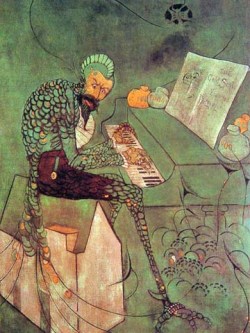 Dave and I were at the de Young Museum on Sunday afternoon. I haven’t been there more than once or twice in my life, and probably not in well over a decade; Dave, on the other hand, has been there many times throughout his life (he grew up in the Bay Area), and he’s familiar with a lot of the collection.
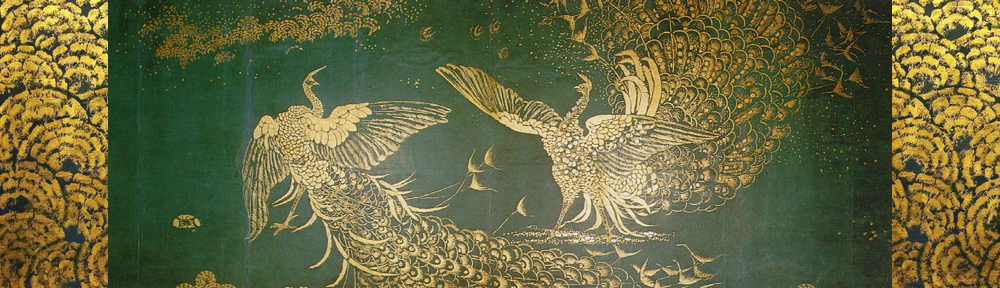
 The banner at the top of this blog is adapted from the mural Whistler painted on one wall of the room. The peacock on the left represents Whistler himself, and it is fleering at the peacock on the right, who represents Leyland. Leyland’s peacock has silver shillings in among its gold breast feathers, has silver shillings in place of eyes in its tail feathers, and is standing on a pile of gold coins and silver shillings. (The whole wild story is both sad and funny, and the loss of Leyland’s patronage was a self-inflicted blow to Whistler’s finances that he never recovered from.)
 Scratchings