Die Fledermaus at Opera San Jose

I should probably mention what I’ve been working on. Opera San Jose is doing a production of Die Fledermaus in the near future, and they want to do all the singing in German but all the spoken dialogue in English. But the director, Marc Jacobs, dislikes all the English translations he’s been able to find. (And rightly so, in my humble opinion — I know of only two that manage to be better than godawful, and even those two, though they do capture the spirit of the original, are wordier and less sharp in the writing than they should be. And don’t get me started about the horrible, horrible version the Metropolitan Opera did in the 1940s or whenever it was.)

So Marc read my Bat out of Hell, an adaptation of Die Fledermaus set in Berkeley in 1998 at the end of the dot-com boom. He loved it, but of course he can’t use it because the company insists that the production must keep the story in late-19th-century Vienna and keep the singing in German. So Marc asked me if I’d write a new translation of the spoken dialogue.

Ordinarily I say no to this sort of thing — this stuff just doesn’t pay well enough for me to take time away from the projects that interest me more. But in this case I’ve had it in the back of my mind for some time that I might want to write a more or less traditional English-language version of Die Fledermaus. Alas, though Bat out of Hell has been produced more times than any of my other librettos, it has not been produced as many times as I’ve been told “We’d love to do it, but we’re committed to a traditional production.” And as I said, none of the existing English-language versions are first rate, so a really good one might well catch on and bring in some extra income for me.

So writing the dialogue is one step in that direction, and this production gives me a motivation to get that done.

Another thing that interested me about this production is that, though they’re keeping the story in Vienna, they’re updating it from 1870 to 1890. I gather that the reason has more to do with wanting to give the production a Belle Epoque look and feel than anything else, but Marc mentioned that he was also going to make Dr. Falke a psychoanalyst à la Sigmund Freud, and that caught my interest.

So I’m having some fun with the idea that Gabriel, Rosalinde, and Adele all have secret fantasies and desires that they’ve been repressing in various ways, and that come out at Orlofsky’s ball — sort of a tongue-in-cheek take on Freudian psychology.

I’ve finished my first draft of the whole thing, and I’ve done the final polish on the first act — with the one exception of the beginning of the third act. It’s become traditional to build up the part of Frosch — a small part in the original — into a star turn for a good non-singing comic. (This was first done by Max Reinhardt for his lavish, all-star 1929 production in Berlin, and it was so widely imitated that practically everybody now thinks it was written just that way in the original.) Marc has asked me to do the same thing here, as he’s got a good comic for the role.

The way this is usually done, though, is to give Frosch a big comic solo drunk scene. I dislike that approach, partly because drunk scenes seem facile and not all that funny to me, but more importantly because it steals the thunder from Frank’s drunk scene that immediately follows it. Two drunk scenes in a row is two too many for my taste, but Frank’s is important to the plot and embedded in the music, so it pretty much has to stay. So whatever Frosch is given to do right before it shouldn’t make it seem like a weak echo.

Hence, in Bat out of Hell I wrote an entirely different sort of comic turn for Frosch at the start of act three. I can’t use anything like that one in this production, though, because the things it satirizes are modern. So I’m trying something very different. But still, not a drunk scene. I’m hoping to finish it tonight. We’ll see how it comes out.

Fun Fact of the Morning

The lab notebooks and other papers of Marie Curie are available for study at the Bibliothèque Nationale de France. They are kept in lead-lined boxes, and in order to look at them you have to sign a waiver of liability and wear protective clothing.

Salomania at the Aurora

Dave and I saw Mark Jackson’s new play Salomania at the Aurora Theater last weekend. It’s a terrific piece of theater. I’m nearing a deadline so I can’t take the time to write much about it, but this is the last weekend so I wanted to at least mention that it’s well worth seeing.

What’s most awesome about the play is the staging. The play itself is something of a collage of scenes that take place in a number of very different locations — a World War I battlefield, a London courtroom, a pub, the central character’s memories and fantasies, to name a few. I thought the dialogue and characterizations were mostly rather weak and two-dimensional, but the staging is brilliant and makes it all work. The way that the scenes are juxtaposed — often even superimposed — and played out on Nina Ball’s wonderful set is consistently breathtaking and beautiful.

Seven actors play all the parts. The cast is consistently good. Madeline H.D. Brown is terrific as Maud Allen, the controversial dancer whose libel suit against a reactionary newspaper is the center of the play.

Among the others, I thought Kevin Clarke was a particular standout, bouncing back and forth deftly among three (or was it four?) different roles and making them all distinctive and engaging. (He did a similar task in Mark Jackson’s God’s Plot at Shotgun Players a while back, and with similar panache.)

I think this is only the second play of Mr. Jackson’s I’ve seen, the other being God’s Plot, and I thought that play had similar weaknesses in the writing but phenomenal strengths in the staging. But we’ve seen a few other plays directed by him, and they’ve all been strikingly staged and acted. I’d say Mr. Jackson hasn’t found his voice yet as a writer, but as a director he’s amazing.

Spunk at CalShakes

Dave and I saw Spunk at California Shakespeare Theater Friday night. It’s terrific! Full of life and spirit and color and playful invention, lots of music, and tons of heart. The show is based on three stories by Zora Neale Hurston (an author I’ve been meaning to get to know better for several years now, but haven’t actually read yet), adapted by George C. Wolfe.

Among other things, I am extremely grateful to be able to say now that I have seen Peter Callender jiving around the stage in a vivid red-orange zoot suit, which he does in the middle piece, “Story in Harlem Slang”. Not the usual sort of role for him, but he’s terrific.

I was a bit startled at first by the earthiness of some of the language, which even includes one use of nigger, flung as part of an insult from a black man to his wife, and several instances of Zigaboo, sometimes shortened to Jig, used very casually among the characters in “Story in Harlem Slang”, all of whom are black. I wasn’t shocked — like most people I know about my age, when I was a child I was taught that nigger was the worst kind of hate speech and never to be used under any circumstances whatsoever; but I’ve had a couple decades by now to get used to hearing young people of all races using it among themselves as though it were just teasing. All the same, I found it startling to hear the words used in a play set in the 1930s. Obviously, I have to assume that they’re in the play because they’re in Ms. Hurston’s stories, and that they’re in her stories because she heard them used in this way in the Harlem culture around her. So the use of those words in Ms. Hurston’s stories kind of skewers my perception that that kind of casual use was a recent thing.

Anyway, I don’t want to make too much to make out of a few words. Overall, the language in the play is vibrant with life and color, and I’m looking forward to reading the play so I can savor it better — the second piece in particular is loaded with unusual turns of phrase that rush by, one after the other.

I thought Peter Callender was a standout as Sykes, a tyrannical (and cheating) husband. But everyone in the cast is terrific, and they all get their turns to shine. Dawn Hall makes the emotional journey of Sykes’s long-suffering wife vivid, both moving and very funny. Dawn L. Troupe sings many of the songs in the play, and beautifully. Tyee Tilghman is a hoot in the second story as a hick who comes to Harlem and becomes a suave ladies’ man. Aldo Billingslea and Omoze Idehenre give complex and endearing performances in the third story (the best of the three, it seems to me), “The Gilded Six-Bits”, as Joe and Missie May, a pair of newlyweds whose happiness is troubled by the temptations of higher living. (It’s a really beautiful piece of writing, too.)

Or Maybe It Just Needs the Word “Technically” in There Somewhere

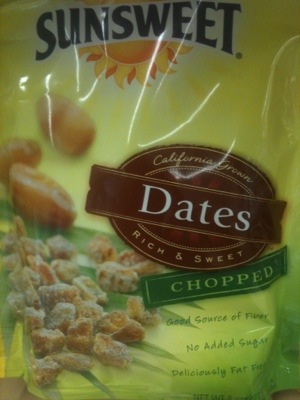
OK, I’ve baked a lot, and I completely understand that you have to coat chopped dates in something, because otherwise they’ll stick together in clumps just as large if not larger than the dates were to begin with, and what would be the point?

In baking, one generally uses flour, because the muffins or whatever you’re baking are largely flour anyway, but I understand that if you are selling a package of chopped dates, you don’t want to use flour because the customer might want to use them for something other than baking (like, for instance, to mix into one’s bowl of yogurt for breakfast), and they’ll taste floury.

I don’t even really mind all that much that it’s dextrose the chopped dates are coated in. It’s not that much dextrose, really, and I eat plain yogurt which is sour to begin with, so a little added sweetness isn’t a bad thing.

But come on, good people at Sunsweet, how can you coat your chopped dates in dextrose and then in good conscience print on the front of the package the words “No Added Sugar”?

20120713-111207.jpg

20120713-111333.jpg

The Scottsboro Boys at ACT

Dave and I saw The Scottsboro Boys at ACT last week, thanks to a discount offer on Goldstar. It’s Kander and Ebb’s last score, as Fred Ebb died before the show was finished.

The show is based on the case of the Scottsboro Boys, nine black teenagers sentenced to death for raping two white women in Alabama in 1931, despite a conspicuous absense of evidence that any rape occurred at all, and the two women having rather obvious reasons to lie. The show uses the minstrel show as its central metaphor — in addition to the nine young men, there are a Mr. Bones and a Mr. Tambo, who play various parts, and an Interlocutor. (There’s also a black woman who watches the story silently — her purpose is a mystery for much of the show but becomes clear by the end; I’m not going to give it away.)

As I watched the show, though, it seemed to me that the use of such an emotionally charged metaphor was never really justified, even though it’s used in some inventive ways. There were moments when I thought the point was going to be that people on all sides looked at the case and saw whatever they wanted to see, in the same way that most blackface performers relied on the audience bringing in with them a willingness to see its simple preconceptions about blacks reinforced. But this idea was never really developed.

Besides which, the show itself, it seems to me, relies on a liberal audience bringing in a willingness to see its simple preconceptions about racial prejudice reinforced. The young men are guileless victims, the white Southerners are venal buffoons. This is fun for a while, but well before the end of the show I was wishing there were some three-dimensional characters somewhere. If this play were about an issue that we didn’t come into the theater already having strong emotions about, I don’t think we’d be stirred. The show paints everything in big, broad strokes and downplays or eliminates all sorts of inconvenient human complexities about the case that could get in the way of our seeing it in simple good-versus-evil terms.

Nothing is said, for example, of the fight that started the whole mess. Nothing is said of the fact that, during their trials, some of the young men were frightened into claiming under oath that they witnessed the alleged rape and accused others of having taken part in it.

It seems to me that the script verges on out-and-out dishonesty at the end, when we’re told that Haywood Patterson, one of the young men, died in jail, and the clear implication is that he was still serving his sentence for the nonexistent rape. In fact, Mr. Patterson managed to escape after 18 years in jail, and he fled north to Detroit, where he lived in secret for three years until the FBI arrested him; the governor of Michigan, however, refused to extradite him, and he gained his freedom. But less than a year later, he killed another man in a fight; Mr. Patterson claimed self-defense, but he was convicted of manslaughter, and it was while he was in prison for this crime that he died of cancer at the age of 39.

Which, it seems to me, is a pretty darned compelling story. Which makes it all the more frustrating that the one actually told in the show is thin.

From what I’ve read, in fact, Mr. Patterson had quite a mix of admirable virtues and serious faults — hot-tempered and easily pushed to violence, yet passionate and intelligent — in both cases, to a much greater degree than the play shows us. His too-short life would make a terrific story for the stage, I think, but this one seems to me to shy away from both extremes, downplaying both his faults and his virtues, making him out to be a very ordinary guy trying to find his path in an extraordinary situation. As I write this, I realize that this is a perfectly valid story to want to tell, but turning a fairly recent historical event into something very different and yet continuing to say that you’re telling a true story seems a bit dicey to me. Maybe the writers would have done better to turn it into an explicitly fictional event, like the trial in To Kill a Mockingbird, or found an actual event that better fit the kind of story they wanted to tell.

There’s another and more abstract reason that I’m not wild about the minstrel show metaphor, too. I’m just feeling like I’ve seen this basic device tried over and over and over again in musicals: An unpleasant story, or sometimes just a particularly unpleasant part of a story, is told for ironic effect through the relentlessly upbeat music of some bygone popular song style or styles. I’ve occasionally seen it done brilliantly, as in Chicago, the Loveland sequence in Follies, parts of Assassins, the Grand Canal sequence in Nine. More often I’ve seen it done not so brilliantly, as in Grind, Barnum, Rags, and so on and so forth and so on and so forth. Ultimately it’s a device that’s difficult to get a lot of depth or scope or heart into, and I’m kind of tired of it. I remember already being kind of tired of it in the musical theater writing workshop I was part of for many years way back in the 1980s. I’m tired of it even though there’s such a sequence in the second act one of my very favorite musicals, The Golden Apple (which as far as I know was the first show to use the device in any kind of extended way, back in I think the 1950s).

I hate to crab so much about the show, though, because in spite of all this, there are a lot of things in it to enjoy. The performances are winning. The singing is great. The dancing is absolutely spectacular. But I kept hoping for more depth and character in the story, given the seriousness of the subject matter, and it never got there.
Brave and Magic Mike

Dave and I saw Brave two nights ago, and Magic Mike last night. I enjoyed both of them, though in different ways of course.

Brave has been resonating deeply with me the more I think back on it — I wouldn’t be too surprised if I end up thinking of it as one of my favorite animated movies ever, up there with Pinocchio and Spirited Away. Brave has a lot going on, a lot of levels of meaning weaving in and out of each other — an engaging story, myth, comedy, psychology, spirit. Some of the character animation in the second half of the movie is as on target and touching as any I can remember. The story is well constructed and touches on a number of themes very close to my heart — the place of myths and legends and dreams in our lives, healing broken relationships, inner transformations. And there’s a wonderful, heartfelt twist at the end that I loved but can’t say anything about without giving it away.

Magic Mike is a better movie than we were expecting a movie about male strippers to be, well done and likable and not cheesy at all. The script is surprisingly good, with a lot of genuine humor and well-drawn characters. The acting is good, low key but natural and convincing. The story is simple but engaging. And the dancing is really spectacular. Channing Tatum’s dancing in particular is amazing and exciting even apart from the fact that he’s stripping while doing it — he’s OK when he’s speaking lines, but he’s downright awesome when he’s flying around the dance stage.

Bartók’s Duke Bluebeard’s Castle at SF Symphony

Dave and I just got back from hearing this. Wow! A favorite opera of mine, really wonderfully performed and sung. Just one more performance Saturday night! Go if you can!

It’s a strange one-act opera, surreal and hard to get a handle on, but one that I enjoy more and see more deeply into every time I hear it. Duke Bluebeard brings his new wife, Judith, home to his castle. The castle, she finds, is dark, damp, and windowless. There is a great hall, however, with seven large doors, all locked. Judith demands the keys so that she can open the doors and bring sunlight and air into the castle. Bluebeard refuses at first, but Judith insists, and he lets her unlock just one. And then just one more. And then another, and another. That’s it, the whole story, just the unlocking of the seven doors one at a time and discovering what lies behind each one.

The libretto is puzzling but it resonates deeply, at least for me, and the music is wonderful. I hadn’t listened to it in a long while and I’d forgotten how seriously creepy and chilling those harp arpeggios are when Judith unlocks the sixth door. Brrrr!

I’m told you can get tickets for tomorrow at close to half off if you order them on the San Francisco Symphony’s website and use the promo code OPERACASTLE50.