Slowly Returning to Life

Haven’t blogged or tweeted or much of anything in a while. Way behind in answering my email, too. Too busy, too grumpy, too just plain tired.

Dave’s bookstore, The Other Change of Hobbit, had to relocate, and most of my weekends and evenings for the last month and a half or so have been spent helping out with that — packing boxes, moving boxes, unpacking boxes, putting up bookcases, putting up signs in the window, and so on. But the bookstore is open in the new space now and I’ve started having some time again in the evenings and on the weekends for doing laundry and writing and sleeping and stuff.

I’ve been frustrated at not making a lot of progress on the new play I’m supposed to be working on. I was very excited to start on it and then just a couple of weeks after I started, I started spending every available hour helping with the move and could work on the play only in scattered quarter-hours and half-hours here and there. There may be writers who can do that well but I find it very difficult. When I sit down and start to work on a piece of writing, it often takes me a while to get into it, to face down the demons and stop hating the sound of my own writing, and stop worrying that what I’m working on is embarrassingly bad and I’ll never finish it and even if I do, nobody is going to want to perform it, and stop worrying that there’s going to be some technical problem in the next scene that I haven’t yet noticed that makes the whole story impossible to tell on stage, and stop wondering if maybe I’d be more successful by now if I’d gotten into writing novels instead and maybe it isn’t too late for me to make the switch. If I only have 20 or 30 minutes here and there, I feel like I’m always having to stop just when I’m finally getting started, over and over again.

But in the last week I’ve had a little more time, and things seem to be starting to flow a little better again. And the two and a half scenes I’ve written so far do seem very, very good to me.

Plus I’ve been getting more sleep, always a good thing.

Behinder and Behinder

Spent much of the weekend again at the bookstore’s new location, mostly figuring out how to make bookcases stand securely, without teetering or toppling, in the arrangement Dave wanted them. The ones standing against a wall, of course, are easy; the tricky ones are in the middle of the floor with nothing near them to anchor them to but other bookcases. But with some ingenuity and some spare lumber, I got them all up and pretty solidly in place. No guarantees if the Big One comes, but at least they won’t come down in a mild tremor or if a child tries to climb one. Or a cat, more to the point. The cats have been having fun jumping on and off them ever since we turned them loose in the new space.

So I’ve been at the bookstore every evening and weekend for a couple of weeks and am behind in everything. For example, it’s Tuesday and I’m still working on Friday’s Listener crossword puzzle, “Double Cross”. The instructions say that each clue actually leads to two words of the same length, and the solver has to figure out which one goes into the grid. This being the Listener puzzle, I figured that this was going to mean that I wouldn’t be able to tell which words went into the grid and which didn’t until I was just about finished, and that I’d need two copies of the grid, one to fill with one set of words and one to fill with the other, and that something near the end of the process would tell me which was the right grid.

Sure enough, that’s what’s going on so far. Things were getting so messy that this morning I took the puzzle into Pages (page layout software) and created one PDF with two copies of the grid and a second PDF with all the clues on one sheet, and recopied all my work so far onto those. That’s a little easier to work with. I have the grids about two-thirds filled in. A “cautionary message” is created one letter at a time as you solve the clues, and I have enough of these letters (about three-quarters of them) to be pretty sure what the message is going to be, but I have no idea yet how it’s supposed to help me.

Bookstore Moving, Everything Else on Hold

Dave’s science fiction bookstore in Berkeley, The Other Change of Hobbit, is moving to a new location (at 3264 Adeline, two blocks south of the Ashby BART station and a couple doors down from The Vault restaurant). They’ve been in their current location for 17 years and have accumulated a ton of stuff that now has to be moved. Of course, being an independent bookstore nowadays, this all has to be done on a shoestring, but quite a few regular customers have pitched in and helped. I’ve been helping mostly with the setup in the new space, figuring out how to arrange the bookcases and bolting them to the walls and so on. I worked through the last two weekends on the move and I’ll probably work through this one, too.

The store is currently open just 5 pm to 7 pm. Four cases of new releases and eight cases of paperbacks are now stocked. The new store has twice the sales floor space but a small fraction of the storage space, and a lot of stuff that has been in boxes in the basement for years is going to be going out on the sales floor as we get more cases up. Our goal is to be open full days tomorrow and Sunday, and then a grand opening next weekend.

Meanwhile, I’ve been bushed. I’m starting on a new play, my first spoken play in quite a long time, and I’m eager to work on that but I’ve had very little time for it. After the move is over I may take a few days off work and focus on that. I’ve got an outline and good first drafts of scenes two and three and a part of scene one, which I’ve written in small chunks of time here and there, but that’s less than half the first act, and there will be three.

Unusual Sight

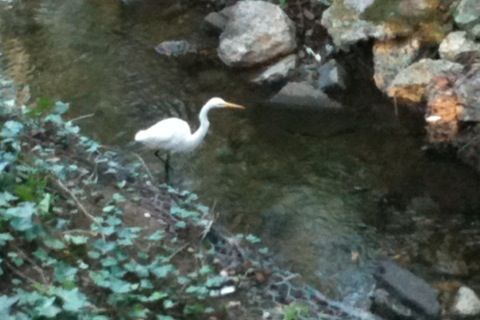
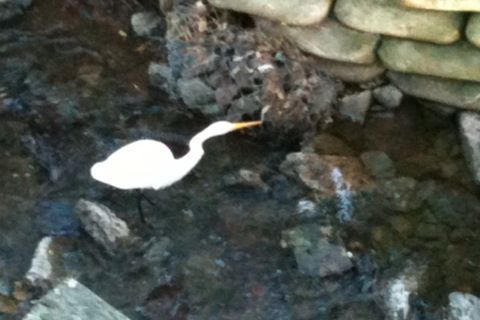
A great egret wading up in the creek in Twin Pines Park in Belmont, poking its beak into the grass here and there at the water’s edge as it strolls. Must be stopping for a cool break on its way to somewhere else.

Random Quotes

After a few hours of searching around the web to decide, first, whether I wanted to do this in PHP or in Javascript, and second, which script I wanted to appropriate and modify for my purposes, and then some fiddling around with the template for my website, tweaking a line of code and re-uploading the page and seeing whether I had gotten any closer to what I had envisioned and trying again, I have gotten a random quote to appear in the sidebar of every page of my website — not this one, my blog, because WordPress.com won’t let you embed either PHP or Javascript into your template, but the website about my libretto writing, Juggling in Handcuffs, at dsmarley.net.

My plan is to have two random quotes displayed in the sidebar of each page that comes up, one being a random quote from my reading and the other being a random quote either from a good review of my work or from one of my librettos.

The curious part of this process is the preparing of the array of quotations. I cannot for the life of me figure out where among the many, many files for my old blog the list of my quotations was kept by the random-quote plug-in script I was using. I’ve tried to untangle the PHP script that find a pointer to where each quote was stored; I’ve tried doing searches on the files for “quote” and for the names of a few of the authors and for a few of the words from the quotes, and haven’t turned up anything. How can the data not be somewhere in the old blog files? Maybe the software was secretly storing everybody’s quotes on some server in Uzbekistan that is going to be the future home of the ultimate quotations website and all of us innocent users have been doing the work of inputting the billions of quotations that will make up its database, a collection so vast that nobody will ever bother visiting any other quotations websites again and all the Google ads revenue will be theirs alone.

However, not that long ago I had made a PDF of a browser display of a list of all my quotations, and so, not being able to figure out any more direct method of creating the array I need, I’ve been cutting and pasting from the PDF, one quotation at a time. And the result is that, as I go, I’m spending a few moments revisiting each quotation and remembering, or in a few cases trying unsuccessfully to remember, why I liked it and added it to my list.

What’s clear is that I’m not quite the same person who compiled this list. There’s overlap, of course. Some of the quotations still hit home very strongly for me. Others, though, no longer have quite the same punch for me that they once had. A few have so little punch left that I’ve deleted them from the list, though mostly I’ve leaned in the direction of letting the borderline ones stay on the list, maybe out of a feeling that I ought to preserve a feeling of friendly regard for my past selves, or maybe from the geeky desire never to throw away a piece of information that might someday be useful. Who knows, maybe in a few more years I’ll become once again the sort of person who finds this particular quotation stirring and I’ll want to find it again. Realistically, I know the odds are astronomically against it ever happening, but who knows, it might.

I carry around the illusion, of course, that I am the same person from one moment to the next, and no matter how much I understand cerebrally that this is only an illusion due to how slowly, though constantly, I am changing, it’s still always a strange and startling thing to come face to face with who I was long enough ago that the differences are very noticeable. I look at the next quotation and as I cut and paste it into my list, I remember why I jotted it down and where my head was at back then. Sometimes it’s something that used to be important to me but I hadn’t thought about in years. Sometimes it’s still important to me. Occasionally I can’t remember why I jotted the passage down at all.

And of course I’ve been continuing to jot down favorite passages from my reading, so I have new items to add to the list, too. I’ve already put a few of them in, though just a few so far. I’ll get them all in. I want to give my future selves something to think about, too.

Down With Holidays

This time of year is usually rocky for me. This year is maybe harder than usual because it was only a year ago in late November that my mother died, and that brings up old memories that feed too well into the persistent feelings of worthlessness that I’ve struggled against my whole life and that I find myself struggling against again now.

But the holidays are always difficult for me anyway. It would be easier if I could just go about my business without being constantly taunted with it, but of course our whole damn economy is organized around reminding us all at every opportunity that we’ve got Thanksgiving and Christmas coming up. Starting the day after Thanksgiving, every freaking store everywhere turns the canned music up and plays the same fifteen novelty songs over and over again. In December I find myself wondering over and over again whether I really need to make this trip to the market, or can I make the rest of the laundry detergent stretch until after the new year?

When I was a child, the very blackest days of the year were Thanksgiving, Christmas, and Easter. Those were not the only three days of the year when my family — the portion that ever saw each other at all, anyway — would get together to try to hurt each other. But those three days were especially horrible because instead of a family visit lasting a mere hour or so, the visit on one of these agonizing days would last ten to twelve hours. By the time I was nine or ten, I had learned to dread these days weeks in advance.

One thing that made these holidays difficult is that they included a meal, and my mother’s mother used food as a weapon. Once, for example, when I was maybe ten or so, for some inexplicable reason my parents and my grandparents decided it would be a good idea to take a week’s vacation together, along with my brother and me, to a cabin in the mountains that my grandfather owned. On the second afternoon I was eating a plate of potato salad that my mother had made, when my grandmother snatched the plate out of my hand, scraped the contents back into the bowl, and added several more ingredients while making a big haughty fuss about how I shouldn’t have to eat that and how she would show my mother the way to make potato salad properly. Once she had corrected the defects of the potato salad, she put some back on my plate, handed it back to me, and demanded that I taste it and announce in front of the entire family which one I liked better. I was mortified and the only thing I could think to do was to say that I couldn’t tell the difference, and the result was a bitter quarrel and a sulk that lasted several days until finally some of us left early (I don’t remember now whether it was my parents and brother and me or my grandparents who left).

I learned early in life for incidents like this, then, that it was a very dangerous idea to have food preferences, or at least to express them. Or indeed to express any preferences at all.

For Thanksgiving dinner, Dave and I made ourselves a rotisseried turkey and mashed yams and steamed broccoli and cranberry tangerine sauce and mushroom gravy, and a pear cranberry crisp for dessert, which was very good and all in all not that difficult. Though part of me would have rather made, oh, grilled cheese sandwiches for Thanksgiving dinner and done the big meal on a non-Thanksgiving evening, just to give the finger more emphatically to my childhood memories.

We don’t haul out the countertop rotisserie as often as we ought to, because it’s not really any more difficult than roasting and the results are consistently delicious.

Then in the last decade there’s been the additional factor that another week and a half marks the eleventh anniversary of my brain surgery, and that always sets me to brooding on whether I’ve really done anything since then to justify the truly staggering amount of time and expertise and trouble and money that went into saving my life, and the long period of chronic pain I went through. I know rationally that this is nonsense, that nobody and nothing needs to do anything to justify its mere existence, and that it’s impossible to do such a thing anyway because none of us will ever learn anything about 99% of the effect, for good or for ill, that we have on the world. And yet around this time of year, when I get tired or stressed out, that’s the direction my thoughts take me in, and I find it very easy to talk myself out of valuing anything positive that I’ve done and into magnifying the awfulness of all the negatives.

And Without Even Interrupting Her Phone Call

Another death on Caltrain today, apparently somebody hit by a train while walking on the tracks in San Mateo. There have been an unusually high number of deaths this year. But it doesn’t seem to me that Caltrain is operating any less safely than the year before. Are people getting more careless?

Well, this evening, as my train was approaching, a young woman was talking on her cell phone while standing right at the edge of the platform, leaning wayyyy over the tracks and peering intently off into the distance as if trying to make out some faraway train. And facing in the wrong direction, of course, to see that in about 15 seconds she was going to get whacked in the back of the head by Lord knows how many tons of steel crawling into the station. Just oblivious, and apparently to engrossed in her conversation to hear the train approaching behind her.

Another passenger noticed this before I did and started making frantic waving gestures to her; she figured it out and scurried out of the way with maybe five seconds to spare. Sheesh.

Labor Day Road Trip

Over Labor Day weekend and the following week, Dave and I drove to Arizona and Yosemite. It was my first time to Yosemite. I’m already back in the busy routine of work and don’t have much time for blogging, so I want to at least get just the outline down. I’ve also got a bunch of pictures to put up.

Thursday, 9/3

We left Berkeley in the mid-afternoon with a rented SUV packed with our luggage, our camping equipment, and 13 boxes of books. Another 12 boxes had been shipped to my father’s house in a suburb of Phoenix. Our destination was DiscWorld in Tempe, Arizona, a science fiction convention focused on the books of Terry Pratchett. Dave’s bookstore, The Other Change of Hobbit, was going to have a table of books for sale.

The drive south on Interstate 5 was smooth and uneventful, and we reached the Grapevine at twilight. Then east to San Bernardino, where we spent the night at a Motel 6.

Friday, 9/4

We drove east into Arizona and reached the hotel in Tempe where the convention would be around 2:00 pm. We unloaded the books and set up the tables in the dealers’ room. I had a bit of a headache, not bad but persistent, lasting much of the afternoon. In the evening we headed over to my father’s house, where we’d be staying. We bought takeout Chinese food and had dinner.

Saturday, 9/5

Dave had arranged things so that he wouldn’t need to cover the tables on Saturday, so we were able to spend the day together seeing some of Phoenix. We took a hike in Papago Park, and visited the Arizona History Museum in the park. It was a free-admission day, but the museum was still a bit of a letdown — it looked rather as though a lot of money was spent to build the museum and then funding dried up to update and add to the exhibits. We were done in 90 minutes. Had we but known, we would have skipped the museum and spent the time instead in the Desert Botanical Garden on the north side of Papago Park.

Sunday, 9/6

Dave was selling books at the convention on Sunday. I spent much of the day with my father, taking his dog Max for a walk in the morning and then to a local dog park in the afternoon. My father also showed me some of his old papers that he’s been going through. He’s a mechanical engineer who worked in aerospace for many years, and has a lot of interesting old stuff. It helps that I’m a technical editor working on (among other things) engineering books, so that I can sometimes halfway understand what I’m looking at.

Spaghetti dinner at my brother and sister-in-law’s home. They’re both teachers (history and math respectively) and progressive Christians and always interesting to talk with.

Monday, 9/7

Dave and I got up early to spend an hour or so at the Desert Botanical Garden before the dealers’ room opened. The garden turned out to be quite large and very interesting, and we probably could have spent at least three or four hours there. Something to put on our list for another trip. Dinner at my brother’s again.

Tuesday, 9/8

We left in the morning, driving west back to San Bernardino, and then north along Interstate 395, coming up the east side of the Sierras. Once we got away from the cities, the drive was very pleasant. On a long drive I sometimes do a sort of “driving meditation”, keeping my focus on what’s happening around me right now, staying conscious of my breathing, especially when I notice my mind has wandered and I want to bring it back to the here and now. This was a very nice stretch of highway to do that on.

We got to the campsite at Twin Lakes a little before twilight. Dave had reserved us a campsite about 30 steps from the edge of a beautiful lake. After spending a few minutes oohing and aahing, we set up the tent and drove back into the town of Mammoth Lakes for dinner.

Wednesday, 9/9

I got up a little before dawn (force of habit — my alarm clock has been going off at 6:15 each weekday morning for long enough that my internal alarm clock seems to be set to go off shortly before that). I had a touch of a headache, not bad but enough that I wasn’t going to be able to get to sleep, so I put on some clothes, grabbed my camera, and left the tent to walk off the headache and get some pictures of the dawn.

As it happened, this headache turned out to be one of the ten-hour wonders I sometimes get. Hydrocodone lightened it but didn’t kill it completely, and made me queasy to boot. Fortunately the headaches I get now aren’t usually incapacitating like they used to be, but I was moving a bit slow till it went away.

In late morning we packed up camp at headed for Yosemite. Along the way we took a couple of scenic detours, first to look at the other nearby lakes and later to stop for a couple of hours at Mono Lake. Then a stop in the town of Lee Vining for lunch. Got to Tuolomne Meadows in the early evening and set up camp.

Thursday, 9/10

Morning was a hike to Lake Elizabeth. Just beautiful, very tranquil, both the lake and the hike to get there — the hike was a high point of the trip for me.

In the afternoon we took a side trip to the old mining town — and now ghost town — of Bodie. It’s an amazing piece of preserved history. I’ve already blogged about the faro table in the previous entry.

Dinner was a simple salad made from lettuce, tomatoes, and fruit purchased in the general store nearby.

Friday, 9/11

We got up and ate breakfast, then packed up the tent and equipment and drove out of the campground. We parked a little way down the main road and took a hike through Tuolumne Meadows. Then we stopped by the general store to pick up something to eat later for lunch. They weren’t making sandwiches yet — too early in the morning still — so we bought a loaf of bread, some sliced turkey, and a ripe avocado to make our own with.

We drove west and had lunch at a picnic table on the shore of Lake Tenaya, sandwiches and leftover salad. As we ate, several Stellar’s jays showed up and watched over us, clearly waiting for us to finish so they could look for dropped crumbs. Then we got back in the car and headed west out of the park and back to the Bay Area. As we drove, we passed an astonishing number of cars coming the other way, so I’m glad we went during the week and not on the weekend.

On Case Keepers

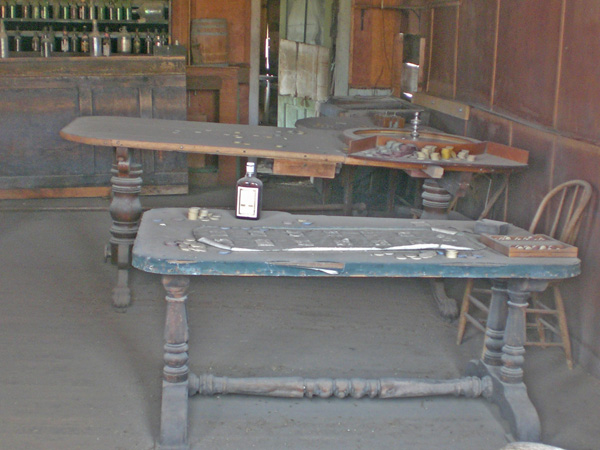
Faro table in saloon at ghost town of Bodie, CaliforniaThursday before last, Dave and I visited Bodie, an old mining town turned ghost town in the eastern Sierras. It’s a fascinating place, and I also accomplished a small personal goal there, which will take some explaining.

A couple years back, I wrote an adaptation of the Puccini opera The Girl of the Golden West, which is set in a Sierra mining camp in the first years of the Gold Rush. As far as I know, mine is the first and only English version that has anything like the right kind of language, that has the characters singing in the authentic American dialect for that time and place. There’s a faro game going on during much of the first act, and I wanted to get the actions and the table talk right, so I did some research into the rules and language of faro.

(As far as I can tell, by the way, the Italian libretto gets it all very wrong, as though the librettists just made up a lot of rules and terminology. Unless perhaps faro was played rather differently in Italy. Though even that would be only half an excuse, as the story takes place in the California Gold Rush, not in Italy.)

And it wasn’t just the table talk that depended on getting the rules of faro right. At a very important point in the first act, the central character, Minnie — the “Girl” of the title — reminisces about her childhood. Her parents ran a saloon, and she remembers her father running the faro game and her mother sitting at the table with him. The memory is important for understanding her character and her actions later in the play. Here she is in the original Belasco play:

And me, a kid as little as a kitten, under the table sneakin’ chips for candy. Talk about married life! That was a little heaven. I guess everybody’s got some remembrance of their mother tucked away. I always see mine at the faro table with her foot snuggled up to Dad’s an’ the light of lovin’ in her eyes. Ah, she was a lady!

So why was Minnie’s mother at the table? The Italian libretto assumes that she was one of the players:

Mother was lovely, she had pretty little feet:
Sometimes she played, too, and I,
hiding myself under the table
waiting to catch any coins that fell,
would see her secretly press my father’s foot —
They loved each other so much! Ah!

But that doesn’t make any sense. It would look — and in fact be — very improper for the part owner of the saloon to be a player in a gambling game being run by her own husband, the other part owner. At this point in the story, there has already been cheating at cards, and there will be more later on, and it’s a crucial point of Minnie’s character that she greatly admired her father for his honesty as a faro dealer. So the very last thing I want to do is have anyone in the audience thinking that the point of the anecdote is that Minnie’s mother and father were cheating by passing signals to each other under the table with their feet, and that Minnie was mistaken in thinking that her father was an honest man. (In fact, it would be pointless to try to cheat in this way at faro, because there’s no useful information you could communicate in this way. But the audience doesn’t know the rules of faro and won’t know this.)

As a secondary matter, I really hate the line in the Italian libretto about Mother’s pretty little feet. What on earth does the fact that her feet were small and pretty have to do with the point Minnie is trying to make with this anecdote? So I was hoping to find other, more worthwhile words to put on those notes.

In Belasco’s novelization of the play, Minnie says more:

“Why, mother tho’t so much o’ that man, she was so much heart an’ soul with ‘im that she learned to be the best case-keeper you ever saw. Many a sleeper she caught! You see, when she played, she was playin’ for the ol’ man.” She stopped as if overcome with emotion, and then added with great feeling: “I guess everybody’s got some remembrance o’ their mother tucked away. I always see mine at the faro table with her foot snuggled up to Dad’s, an’ the light o’ lovin’ in her eyes.”

The lines in the novel are loaded with character, and I knew I wanted to try to capture some of that flavor in my libretto. (The formal, literary language that the characters speak in the Italian libretto is breathtakingly wrong for this story, and why all the existing English translations I’ve seen emulate it is beyond me. It’s bad enough that it sounds ridiculous to American ears for characters in the Old West to be speaking formally correct English, but worse, the marked difference in background and education between Minnie and Dick is crucial to the story and crucial both to why they’re attracted to each other and to why they have trouble opening up to each other, and it ought to, needs to be reflected in how they speak, as it is in the play. If you’re not hearing that difference between them in every dialogue they have together, you’re not getting what is maybe the single most important thing about their relationship.)

But for all the color of the lines in the novel, the matter was still puzzling. What was it that her mother was doing to help at the table, exactly? I felt I needed to know in order to get Minnie’s reminiscence right.

With some reseach, I found the answer: An abacus-like device called a case keeper or case counter was used at the faro table to keep track of the cards that had been played. Usually the dealer “kept case” (kept track of the cards), but if the game was a busy one, the dealer might have an assistant, who was also called the case keeper, or sometimes the lookout. The lookout’s duties included keeping an eye out for sleepers, which were bets made that could no longer win because all four cards of the rank had already appeared; the dealer could claim those as his own if he — or his lookout — spotted them before the players who made those bets noticed them and took them back. Since the case keeper was on the table in full view of everyone, for a player to lose a sleeper wasn’t a matter of bad luck but of carelessless. As the game of faro is a fair one, with the odds giving no advantage to the dealer, spotting sleepers was the only way the dealer could make a profit from the game. I assume that a saloon would run a faro game primarily as a way of drawing in customers who would then buy drinks, and not so much as a way to make a profit from the game itself, but a lookout who was good at catching sleepers would have been an asset all the same.

So in my adaptation, I have Minnie sing:

Square, though — that was Father!
An’ when the game was busy,
Mother sat as the dealer’s lookout.
An’ underneath the table
I’d be keepin’ quiet,
hopin’ someone’d drop
coins on the floor.
An’ I’d see how her foot would snuggle
right up close to father’s.
Lord, they was happy! They was so happy!

It’s not much, only a line about “the dealer’s lookout”, but it’s right, right for Minnie’s character and right for the story, and even though I’d be lucky if one person in the audience had any idea what the dealer’s lookout did, the audience at least gets that her mother was there to help the dealer, not to play.

So now that I had learned so much about a nearly forgotten card game, I’ve wanted ever since to see an authentic faro table and case keeper with my own eyes. I’ve seen pictures, of course. And I’ve seen a faro table now in the Oakland Museum, but there wasn’t a case keeper with it.

Well, in the ghost town of Bodie, they’ve locked up the old buildings, but they’ve taken whatever furniture and other items were left behind when the town was abandoned, and they’ve arranged them in something like the layout they may have had, so that you can look in through the windows of the buildings and see them. And Bodie has one surviving saloon building, and sure enough, in the saloon is an old warped faro table, and on the faro table is an honest-to-god case keeper.

In my photo, the faro table is the nearer of the two tables (the one in back is a roulette table), and the case keeper is at the near right corner of the table.