Omigod, Please Don’t Make Me Want to Go See Legally Blonde

Stuart Bousel — who wrote and directed Troijka last year which I enjoyed — actually liked Legally Blonde, the musical that is playing right now at the Golden Gate Theater. Now, okay, I haven’t seen it, so maybe I shouldn’t venture an opinion just in case I decide to go see it and realize that it’s totally brilliant and thus will be unable to pretend that I’ve been an advocate of the show right from the start. But it sounds like a one-joke idea for a musical to me, and the two songs on the SHN website sound like one-joke songs to my ear, and I had already made up my mind not to see it. Now I’m warily curious.

But maybe I’m just too old for this kind of stuff: Mr. Bousel writes:

It also is one of those rare birds in modern musical theater: something geared to appeal to my age group, and for that I’m actually pretty grateful. It’s getting harder and harder to find fun, entertaining, smart new musicals for the Gen X and Y crowd.

Believe me, it’s pretty hard to find good new musicals for the Gen W crowd, too. But in another blog entry, he wrote that the music for Spring Awakening didn’t sound like “musical music”, and I sort of had that feeling about the two songs from Legally Blonde. It’s attractive, pleasant pop music but it doesn’t convey specific emotion to my ears. But maybe I’m too old and listen to too little of this kind of music to hear nuances in it, I don’t know. It often takes me several listenings before I get a piece of music. First time I saw a Kurt Weill musical, all the songs sounded exactly the same to me; now I wonder what was I thinking? Bruckner still sounds that way to me, every movement of every symphony sounds like every other, yet Dave is a major Bruckner fan and insists that if I listened more, I would get it.

Mr. Bousel adds:

THE WILD PARTY is grand, of course, but it’s more of the arty pursuasion, like PARADE, and feels like it belongs to an older tradition of serious operetta.

Ouch. You say that like it’s a bad thing. I’d drop everything and buy orchestra seats for a good new serious operetta.

My vibes about Legally Blonde have been that it’s going to be yet another story in which the writers spend three quarters of their time relentlessly mocking their characters for being stereotypical and shallow (and whose fault exactly is that, anyway?) and then expect us to feel genuine emotion for them when they get into some kind of crisis and tug on our heartstrings. There are so many movies and plays that try to work that way, they never work on me like they mean to and leave me feeling irritated rather than moved, and Legally Blonde has been looking to me like another one of them.

Can I Rewrite Some Memory While I’m at It?

Apple’s home page for its .mac service has a list of what this service is supposed to let you do. Of course, it’s only natural that they want to hype the benefits, but I think maybe they’re going a bit far:

Publish in One Click with iWeb
Photocast with iPhoto
Exchange Files from Anywhere
Stay in Sync
Communicate the Way You Want
Back Up Your Life
Bring Groups Together

I’m a satisfied user of .mac, don’t get me wrong. But however much I may regret some things I’ve done and not done, I really don’t think .mac is going to let me back up my life.

So What Is He Saying, That the First Two Times He Told Them It Didn’t?

From yesterday’s CBS News website:

In an interview, [House Speaker Nancy] Pelosi also said she was puzzled by what she considered the president’s minimalist explanation for his confidence in the new surge of 21,500 U.S. troops that he has presented as the crux of a new “way forward” for U.S. forces in Iraq.

“He’s tried this two times — it’s failed twice,” the California Democrat said. “I asked him at the White House, ‘Mr. President, why do you think this time it’s going to work?’ And he said, ‘Because I told them it had to.'”

“Black” — It’s the New Black!

A remarkably narcissistic essay this morning on Salon.com about Barack Obama. Well, ostensibly about Barack Obama, though the real subject seems to be the author’s fascination with her own feelings about the media coverage of Obama. It begins:

I am confident that I have held out longer than any other pundit to weigh in on both the phenomenon that is Barack Obama and the question of whether race will trump gender as America looks toward election 2008.

I had irritably avoided columnizing on these crucial topics (though I have been quoted by others) for several, somewhat unorthodox, reasons.

What a maverick this woman is! Waiting until now to write a story about Obama, even though hordes of readers were urging her to weigh in, even though her silence had become conspicuous, even though every thinking person in the nation was saying, “But what of Debra J. Dickerson? Why has she not columnized on this crucial topic?”

Why, indeed. The reason is that, until recently, the media coverage of Obama had been on too low a level for someone like Debra J. Dickerson to join in:

I was waiting for the discussion to get serious and, at last, it has.

The writer is too much of an iconoclast, you see, too independent a thinker, to write anything serious on a matter until others go first. The discussion, you see, had focused entirely too much on Obama’s charisma and good looks for Ms. Dickerson’s liking, and if she refers to Obama’s youthful sex appeal over and over again in her essay, it’s important that we understand that she’s only trying to make it clear to us how unimportant it all is to her:

Horrors, Obama smokes! But isn’t he hot in his swim trunks?

All much more important than why he doesn’t wear a tie.

… sexy Obama might be, but ….

… superstar Obama ….

… the handsome Obama ….

In her ninth paragraph, two thirds of the way through the essay, Ms. Dickerson finally breaks her silence and reveals to an anxiously expectant nation what her thoughts on the matter are, and a devastating bombshell it is, too. For months now, America has blundered around like a toddler exploring the garden, and though Ms. Dickerson saw that we were getting too close to the rosebush, like a loving mother she had bitten her tongue for our own good, knowing that it was best for everyone if we figured things out for ourselves. Now, though, with only 22 months before the election, time is running short, too short for her to stand by and say nothing, and, again for our own good, she lets us have it:

Which brings me to the main reason I delayed writing about Obama. For me, it was a trick question in a game I refused to play. Since the issue was always framed as a battle between gender and race …, I didn’t have the heart (or the stomach) to point out the obvious: Obama isn’t black.

Ah, so that’s why I’ve been hearing the sound of eyes snapping open and palms slapping foreheads all over the country this morning! But of course! Black, Ms. Dickerson is here to inform us,

… means those descended from West African slaves. Voluntary immigrants of African descent (even those descended from West Indian slaves) are just that, voluntary immigrants of African descent with markedly different outlooks on the role of race in their lives and in politics. At a minimum, it can’t be assumed that a Nigerian cabdriver and a third-generation Harlemite have more in common than the fact a cop won’t bother to make the distinction. They’re both “black” as a matter of skin color and DNA, but only the Harlemite, for better or worse, is politically and culturally black, as we use the term.

How could I have not realized this before now! As everyone I know uses these terms, Obama is not black! He’s just “black”! What fools we have all been not to have seen this!

Whites, on the other hand, are engaged in a paroxysm of self-congratulation; he’s the equivalent of Stephen Colbert’s “black friend.” Swooning over nice, safe Obama means you aren’t a racist. I honestly can’t look without feeling pity, and indeed mercy, at whites’ need for absolution. For all our sakes, it seemed (again) best not to point out the obvious: You’re not embracing a black man, a descendant of slaves. You’re replacing the black man with an immigrant of recent African descent of whom you can approve without feeling either guilty or frightened.

And how fortunate we have been to have Debra J. Dickerson, in her infinite grace and benevolence, looking out for us all, showing us the depths of her mercy by withholding her devastating reality check from those who needed so very desperately, for the sake of their own absolutions, not to hear it!

Of course, this morning she went ahead and dropped the nuclear bomb on us anyway and charred our pitiful souls all to cinders with her searing words of truth, but that’s only because, you see, things had changed. The discussion had turned serious, and when that happened it became the path of greater mercy to put us out of our paroxysms.

The only thing is, I live in the San Francisco Bay Area and I hang out on the WELL, both notorious hotbeds of progressivism, and I don’t actually know a single person, white or otherwise, who appears to be paroxysming over Obama, or Clinton either for that matter. Yes, I can see that the news media seem to have decided, 22 months before the election, that the Democratic race is already down to Hillary vs. Barack — but I don’t actually know anyone, anyone, who is in fact wholeheartedly enthusiastic about either of them.

Sure, I hear a lot of “I give Clinton points for all the work she did on health care, but …” and “Damn, that was a great speech Obama gave the other day, though still …”. I do think most of the people I know would find either of them a huge improvement over our current president, to put it mildly. But I can’t think of anyone who puts either of them at the top of his or her list.

There are two politicians I hear that kind of enthusiasm for among some of my friends. Not paroxysms, exactly, because nobody seems to think either of them has a hope of winning the nomination; but whenever I hear someone say, “You know who I’d love to see as the Democratic candidate in ’08?”, the answer to “No, who?” is neither Obama nor Clinton. It’s usually “I know it’ll never happen, but …” and then either Al Gore or Howard Dean.

So where are these reported paroxysms actually taking place? Is it happening all around me and I just haven’t noticed? Or — and I know this is a terrible thing to suggest — but could it possibly be that — that the media is — dare I say it out loud? — could the media possibly be blowing a story up out of all proportion?

But no, what an absurd thought! Unimaginable! How could such a thing possibly be true? The media are the lapdogs of the left wing, the sworn enemies of the corporatization of America — everyone knows that! And given that every single president this country has elected in over 200 years has been a while male, what possible reason could our intensely liberal media have for promoting the idea that, with the election nearly two years away, the Democratic candidate is already guaranteed to be either black or female?
Meep Meep!

John Oliver on The Daily Show the other night, in the process of comparing the situation in Iraq to a Roadrunner and Wile E. Coyote cartoon:

So yes, Jon, perhaps the president has run America off a cliff. But what he’s saying now is, “Everybody, don’t look down!

Wordplay

Dave and I finally watched the documentary Wordplay a few nights ago. It’s a terrific movie, and for me there’s the added interest that I know about half the people in the movie from my 14 years as a puzzle editor and my five years in New York City in the late 1980s. Ellen Ripstein and Jon Delfin were part of a group of New Yorkers who got together for brunch and conversation and puzzles once a month. (Maybe the New York puzzle people still do? I haven’t communicated with a lot of those folks probably since my surgery seven years ago.) We met at Phebe’s in the East Village for a while, and in summer we often picnicked on the grass near Bethesda Fountain in Central Park. My memory is that Will Shortz was an occasional part of that group but not a regular. Trip Payne became part of that group, too, once he moved to New York, which was in 1988 I think. (Then I moved away from New York and to the San Francisco Bay Area in the summer of 1989.) Quite a few other people in the movie like Miriam Raphael and Helene Hovanec I knew less well but saw several times a year.

I met Merl Reagle in the mid ’80s when we living a few miles from each other in Los Angeles. Merl was the one who taught me how to construct a good crossword puzzle. I was living in Los Angeles in a little neighborhood just north of Culver City. Merl lived in a somewhat cramped studio apartment in Santa Monica. He liked to get out of there during the day, so he would hang out a lot in Fromin’s Deli on Wilshire in Santa Monica and work on his puzzles there. There was a period of six months or so — till I got the job at Games magazine that took me to New York — when I was hanging out with him a lot in the afternoons, sitting across the table from him at Fromin’s, each of us working on his own stuff, and every once in a while I’d ask him what I should do about a tough section I couldn’t fill, or he’d ask me if I could think of any interesting words or phrases that fit a certain pattern. When you construct a lot of crosswords, you do a lot of looking at a pattern like, oh, an eight-letter word where the third letter has to be B and the fifth letter can be either M, R, T, or W, and coming up with as many different words and phrases as you can that will fit, so that you can choose the one that works best with the developing pattern or that you think is the most interesting, or actually more likely the one which looks like the best compromise between both of those virtues.

(Let’s see: CUBE ROOT, ALBUM ART, EMBARGOS, RIB STEAK, ELBOWING, BABY TALK, BABA WAWA, LABOR DAY, ARBOR DAY, AMBITION, LOBOTOMY, ROBERSON, DO BATTLE, SIBERIAN, LIBERIAN, NO BETTER, NO BOTHER, AT BOTTOM, ROBOTICS, SYBARITE. There are programs that will give you all the dictionary entries that match **B*M*** and **B*R*** and so on, but you can’t rely just on those alone because phrases like ALBUM ART and BABY TALK and BABA WAWA don’t show up in them, and unexpected answers like that are part of what makes a crossword fun to solve.)

My first crossword took me three days to construct, and when I showed it to Merl, he pointed out that there was one obscure word, and said I should work harder to get it out. But under the house rules of most puzzle magazines, I protested, a 15×15 crossword (that is, weekday size, not Sunday size) is allowed up to six obscure words as long as no two of them cross, and I only had one. And Merl said to me that if I had five or six obscure words in my grid, he wouldn’t tell me to keep working, but that since it was just one, I should work harder to get it to zero. A puzzle with no obscure words at all is much more desirable and salable, he told me, than a puzzle with even just one, whereas there isn’t much difference between a puzzle with say four obscure words and one with five. A puzzle that uses only common words is actually harder to construct, because the constructor has fewer words to choose from, and it’s easier for the magazine or newspaper to place because it’s more flexible. Magazines need puzzles in all levels of difficulty, easy, medium, and hard, and good easy puzzles are often in the shortest supply. What’s more, if an editor finds he needs another medium or hard puzzle and doesn’t have any more in his inventory, he can take an easy puzzle and rewrite the clues to make it harder, but there’s no way he can take a hard puzzle and rewrite the clues to make a word like ESNE or ANOA easy.

In the movie, we see Merl going through just that process of revision, if you know what to look for. We see him at several stages of constructing a puzzle, and we watch as he finishes a tough section by using the uncommon word REDTOP, which is a kind of grass. As I watched him leaf through the dictionary and say to the camera that it was okay because the word was in there, I cringed a little — it’s not like the Merl I knew to settle for a word like that in a puzzle otherwise free of uncommon words. But sure enough, when we see the finished puzzle in print later, the word REDTOP is gone and that section is reworked with only common words and phrases (I think PILE UP is now there where REDTOP was). So even though we never see it in the movie, at some point he must have gone back and reworked it. That kind of attention to the details of craftsmanship is one part of why Merl is one of the all-time great constructors.

It’s interesting to trace my life backward from here and now, and to realize that if Merl hadn’t taught me to construct a good crossword, I probably wouldn’t have gone to New York to work at Games, I certainly wouldn’t have spent over a decade as a puzzle editor, and I probably would not be a technical editor today. Whether my life would have been better or worse today, I have no idea. There were some bad things about working in the puzzle business for so long, but at the same time there was a lot of flexibility about my time, and I don’t think I could have written one libretto a year for so many years with Berkeley Opera if I’d had an office job. Beatrice and Benedict and Bat out of Hell and The Riot Grrrl on Mars and Daughter of the Cabinet were all written while working as a puzzle editor out of my home.

Dave had to put up with my incessant commentary on the movie — “Look, there’s Helene Hovanec! That’s Nancy Schuster! See how that guy checked his watch as soon as he finished? You only lose points for whole minutes, so he can keep double-checking his answers for another 40 seconds. Why haven’t I seen Mike Shenk anywhere — are he and Will on the outs? Where’s David Rosen? Lordy, is that Doug Heller with the beard?” I suppose it’s a good thing we never got around to seeing the movie in a theater or I’d have been kicked out.

It was fun to see Trip solving so well in the tournament in the movie. Trip stayed with me for a few months when he first moved to New York City to work at Games magazine, where he and I and Mike Shenk and Will Shortz were all working at the time. We still communicate by email every once in a while. I should drop him a line and tell him I finally saw the movie. Trip came out as a gay man after I’d left New York, and I think maybe we still communicate now and then largely because of the shared bond of being among the very few openly gay men in the puz biz. (Maybe things have changed in the last seven or eight years, but back when I was working in puzzles that’s how it was.) Trip told me a while back that he’s particularly proud that he’s seen in the movie giving his partner a kiss. Their onscreen kiss is more of an friendly peck than a romantic smooch, but hey, we have to take what we can get.

I wonder whether I should mention to Trip that Dave told me he thought he was easily the most attractive guy in the movie. I think I will tell him that.

Parakeet Music

I imagine every family develops private words and phrases. One of Dave’s and mine is parakeet music. Parakeet music is music that makes our two parakeets dance around and chirp a lot. One might think at first that what they’d like best is something with a lot of twittering flutes and piccolos, but no, what really seems to get them going the most is something with a good strong rhythm. One of our earliest discoveries in this vein, for example, was that Haydn symphonies usually seemed to please them, and the zippy last movement of pretty much any of them would really get them hopping.

Haydn symphonies, ergo, are parakeet music.

Dave just emailed me to tell me that Stravinsky’s The Rite of Spring has proven to be “monster parakeet music”. Way more so, he writes, than the Firebird suite, “which they are only intermittently happy with”.

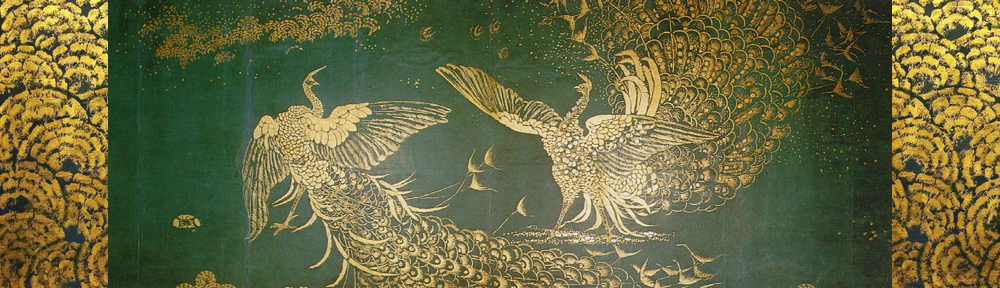
We’ve named the parakeets Maeterlinck and Rossetti (after Christina, mind you, not her brother, first because she’s a she and second because as far as I’m concerned “Goblin Market” runs rings around “The Blessed Damozel”). Explaining why they have such odd names requires a short bit of parakeet history. My first parakeet was a beautiful very dark green, and I named him Whistler, after my favorite painter, because he reminded me of the very dark green of the walls of Whistler’s Peacock Room (the banner at the top of this blog is a mural from this room, so you can see the color in the background there), and also of course I named him that because of the play on words. (Though he didn’t actually whistle all that much, being rather serious for a parakeet.)

After Dave moved in, we acquired a second parakeet, and at one point in our what-to-name-the-baby discussion, I suggested Sargent, after my second favorite painter, John Singer Sargent, so that she would continue the artist theme. And Dave said, no, we should name her Singer, so that she’ll also extend the play on words. So Singer she became.

Parakeets have died and been replaced, but after Singer we ran out of contemporary painters’ names with birdy double meanings. So we’ve just continued to name them after late 19th/early 20th century British artists of various sorts who we like (except of course for Maeterlinck, who was French, but Maeterlinck the parakeet is blue, so it seemed right anyway).

Headline of the Day

Spotted in the LA Daily News and reported on the WELL:

Decapitation Mars Hanging in Baghdad

Later: That headline of course refers to the execution of Saddam Hussein’s half brother. Now I have learned on the WELL that this was a matter of using too long a rope. Apparently the length of rope needed to break the neck cleanly is related to the condemned person’s weight. If the rope is too long, the weight of the person falling will cause decapitation; if too short, the neck may not be broken and the person will die slowly and unpleasantly from strangulation.

Here is a link to the Official Table of Drops created by Britain’s Royal Navy. And here is another to more information than I really needed to know about the physics of execution by hanging.