A book on XML I’m reading today promises to give you a feel for the subject “without weeding through large amounts of information.”
Here’s a Malapropism I Haven’t Come Across Before
Reply
A book on XML I’m reading today promises to give you a feel for the subject “without weeding through large amounts of information.”
I just finished this week’s Listener puzzle, “Vive le Différence” by Kevin. Well, I have the grid filled in, which is all I need to enter the competition. But I don’t really understand it. According to the instructions, “the resulting grid symbolically marks a milestone on a journey begun on March 23, 1991, as calculated from a slightly earlier departure”. I see what is formed by the replaced letters, but I don’t know what the journey is or what the milestone is or what is meant by the slightly earlier departure.
Later: Ah, just figured out what the milestone is and all the rest. Nice.
Heartbreaking photos of oil-covered seabirds on the Louisiana beach.
According to an article in the Guardian, a couple of recent studies suggest that the amount of oil that has been spilled in the Gulf of Mexico so far from the BP explosion is spilled every year in the Niger Delta. But nobody makes any effort to clean those spills up. And that’s been going on for decades.
“There are more than 300 spills, major and minor, a year,” said Bassey. “It happens all the year round. The whole environment is devastated. The latest revelations highlight the massive difference in the response to oil spills. In Nigeria, both companies and government have come to treat an extraordinary level of oil spills as the norm.”
Whew. I just now finished this week’s Listener puzzle, called “Digimix” by Oyler. A number puzzle this week, and a very tough one. In order to fill the grid, you have to deduce eleven pairs of numbers, one of four digits and one of five, which have the properties that (a) they contain between them the nine digits from 1 to 9, once each, and (b) the sum of their squares is a nine-digit number that likewise contains the nine digits from 1 to 9, once each. This nine-digit number is broken into three three-digit numbers, so that each set contains five numbers (a four-digit, a five-digit, and three three-digit). The sets then contain 55 numbers in all, and most of these are clued in terms of grid entries. For example, one of the three-digit numbers is clued as b + e + p, and b, e, and p are entries in the grid (which is like a crossword grid but lettered rather than numbered).
It took me about five minutes on Friday afternoon to break into the grid, as the constructor kindly put an obvious clue in the first set of numbers — one of the three-digit numbers is a multiple of another, so between them they must contain six different digits, none of them zero. Other factors limited the values of the two numbers, and it wasn’t hard to run through the possibilities and find the only one that worked. That quickly gave me six squares filled in the grid.
I am giving next to nothing away by saying that much. It took only five minutes to get those, and then by Friday evening, despite a few pages filled with scribbled calculations that didn’t lead very far (for example, I had deduced that the last digit of a certain grid entry could only be 2, 5, or 8, but I could see any way to use this information to get any further), I still had only those six squares filled. By Saturday afternoon, I had a grand total of eleven. (The grid is nine squares by seven squares, or sixty-three in all.) But on Sunday I spotted a couple of deductions I could make that I had overlooked before, and those put useful limits on what some of the numbers in the sets could be.
I ended up getting out the laptop and doing some of the calculations in a spreadsheet program, and that made things much easier; this would be a much more tedious puzzle to solve with just a calculator. Several times I found that I’d narrowed the possible combinations of a few numbers down to six, or twenty-four, or in one case sixty possibilities, and what I needed to do was run the same series of calculations on all of them and see which ones led to possible answers. Much easier to do this in a spreadsheet, where I could set up the series of calculations just once and then quickly apply it to all the possibilities.
It feels a bit inelegant to me somehow that the puzzle needed this kind of brute-force approach (unless I’m just missing the way to solve it without it); but then, at the same time I can’t actually see a rational reason why a spreadsheet program should seem too much to me while a calculator and a printed table of square numbers seem perfectly acceptable tools to me (which they do); they’re all just timesavers for calculations I’m perfectly capable of making with pen and paper alone but don’t want to because it would be long and dull.
But the puzzle certainly wasn’t all about brute force with a spreadsheet. There were a lot of surprising and tricky deductions I had to make along the way, and it was very satisfying to figure those out.
(For those who find this entry because they’re actually trying to solve the puzzle: Yeah, I found the preamble confusing, too, and I think it’s poorly worded. Try changing the first three words to In each of the eleven horizontal rows of clues below. I was confused by the boldface letters at first, too; they aren’t clues themselves, they’re headings for the vertical columns of clues below them. Capital letters in the clues stand for across entries in the grid and lowercase letters stand for down entries. In the final sentence, I am assuming that missing entries should be missing clues because nothing else seems to make sense; all the entries are missing, obviously, because the grid is blank when you start.)
Just opened up a box of Trader Joe’s organic cranberry green tea. The box says “15 biodegradable tea bags”, but on looking inside, I find that each of those biodegradable tea bags is individually sealed in clear plastic.
Finished the first draft of scene four over lunch. This scene was great fun to work out — the situation contains both a lot of tension and a lot of humor. The first act as a whole (which will be eight scenes in all) ought to feel like a roller coaster ride for the central character, or like a tale out of the Thousand Nights and a Night, with unexpected developments and reversals at every turn. I think that’s how it’s coming out.
There’s a small incident I wanted to work into this scene, though, that I couldn’t — the main character, who can’t read or write, asks somebody to write down a few lines he’d heard and which have some emotional significance for him, so that he won’t forget them and lose them forever. I had worked out in outline how it would fit in with the other events in this scene, but when I got into the actual writing, I found that it didn’t work; from the beginning of the scene the main character is in too much of a life-or-death situation for it to make good sense for him to stop for this matter.
It’s a small moment but it ties into two other moments in other scenes, and if I can’t shoehorn it somehow into scene five, it’ll be too late for it to happen and I’ll have to cut the other two moments as well.
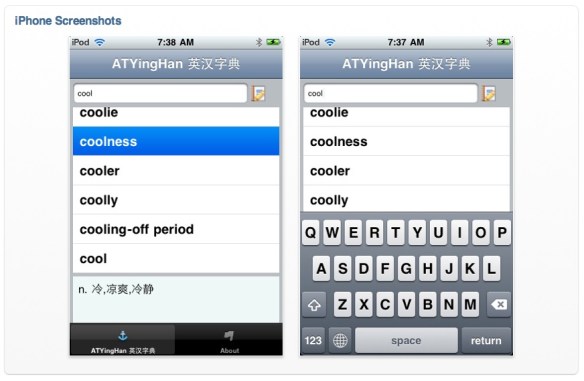
This is the screenshot up on the iTunes store for the ATYingHan English-Chinese Dictionary iPhone app:
Good writing day yesterday. After lunch with Dave and friends, I helped out at the bookstore for a little bit, changing an outlet in the upstairs office to three-prong and putting some curtains over the windows to keep the room cooler. Then over to Sweet Adeline with my laptop and books, where I worked on scene four for a couple of hours. I got four or five pages written — probably about two-thirds of what the length of the scene will be — and I think it’s very good stuff, too.
When I write something meant to be spoken or sung out loud, lyrics or dialogue, I read it out loud as I go. I write the line, and then I imagine myself as the character in the situation and I say the line and see if it feels right for the character to say it. And I also imagine myself in the audience and I try to feel how I’d react to the line if I were hearing it for the first time, and see if it creates in me the reaction I would like it to create in the audience. Usually, of course, there’s something wrong with the line and I have to make an adjustment and try again, and sometimes it takes many, many tries. So there I am in Sweet Adeline, typing away and saying everything I’m typing under my breath, and I can only imagine that anyone taking notice of me was thinking, oh that poor man, he can’t type without moving his lips.
I want to get a good first draft done of the first act (of three) as soon as I can. I think there will be eight scenes in the act, so I’m about halfway there. And it feels very good to be moving forward with it again.
I found this week’s Listener puzzle particularly difficult. I started Friday afternoon, and although it was competing for my attention with a few other things, I must have given it a good hour or more before going to bed that night, by which time I had solved exactly one clue. By lunch the next day I had solved two more.
Still, I chipped away at it, and by the end of the day Sunday I had the upper left corner of the grid filled in. Each answer contributes one letter to a Shakespearean quotation, and I had enough letters at this point to make a good guess at two consecutive words of the quote, at which point I was able to find it easily (doesn’t everyone have a Shakespeare concordance on their cell phone?). The quote then gave me a general idea as to what was going on with some of the clues that hadn’t been making sense.
This morning I finished the puzzle on the way to work, except that I haven’t rearranged 15 letters to form a second quotation. But you don’t need that to finish the grid, you only need to find and highlight in the grid the name of the second playwright, and I’ve done that. So I’m really to submit my entry whether or not I figure out the phrase.
 Scratchings