The Hobbit

Dave and our friend Trenton and I saw The Hobbit: An Unexpected Journey on Saturday night.

We all liked it a lot. The acting is terrific and the adaptation from the novel strikes me as absolutely brilliant. OK, if you go in wanting to see the novel literally and faithfully brought to the screen, you’re likely to be disappointed. That seems to be what is going on with a lot of the reviewers who have panned it: From their reviews, a lot of them seem to have gone in already having decided what an adaptation of The Hobbit has to be, namely a fairly short movie aimed at children, as the novel is. They came into the theater having made up their minds that the novel is too slight to support a trilogy of movies and that this was therefore obviously going to be an overblown movie disaster, and they wanted to write that review so badly that they didn’t notice that what was on the screen was the sort of movie they’d already decided could not possibly work, and it was working.

On the other hand, if, like me, you’ve always found The Hobbit to be an odd and somewhat unsatisfying prologue to The Lord of the Rings, a much slighter book and too twee by half, very Beowulf-meets-Winnie-the-Pooh, then you might be predisposed to be blown away. The novels The Hobbit and The Lord of the Rings may be set in the same world and be by the same writer, but they don’t really go together, don’t feel like they’re cut from the same cloth. And yet — at least judging from this first part — these two movie trilogies are going to end up feeling like two halves of one whole.

The filmmakers have found a way to retell the story of The Hobbit not as a children’s tale but in the style of the movie LOTR. The scenes they’ve added give the story and characters more weight and depth, make connections between what’s happening here and what will happen in LOTR, fill in linking pieces of the history, and so on.

They’ve changed some incidents so that they make use of the same visual language as LOTR, in a few cases even repeating an image to stress a point. For example, the first time Bilbo accidentally puts on the Ring, it happens when he stumbles and falls in a visual echo of the scene in LOTR in which Frodo falls in the Prancing Pony, and it seemed to me to be a wonderful stroke, pointing up the connection between the two events and making the point that here, too, the Ring is actually trying somehow to slip onto the finger of whoever it wants to be its next bearer. This is the sort of ominous point that is never made in the novel of The Hobbit — logically enough, as Tolkien didn’t know yet where he was going with the fantasy world he was creating. In the movie, though, the connections are made, and we can see how the things that happen in The Hobbit and the decisions that are made are eventually going to lead to the story of LOTR. Many of these connections are things that you’d only understand if you’d studied the two novels pretty carefully and/or read the various appendices and ancillary books. I think it’s a good thing to incorporate them into the movies.

The score has plenty of new music, along with new leitmotifs for Thorin and Erebor and Radagast and so on, so I have no idea what some of the reviewers are talking about saying that it’s all just recycled music from LOTR. The score does use themes that are familiar from LOTR for the Ring and the Shire and so on, but even then, they’re often varied in new ways.

We saw the movie in 3-D at 24 frames per second. I didn’t think the 3-D seemed to be adding anything. From what I’ve heard, I’m just as happy not seeing the movie at 48 fps.

The one way in which the movie felt overmuch to me was the number and length of the battles. (This was true for me of the movie of Return of the King, too. For that matter, it’s true for me of the book of Return of the King. In a technical way, I appreciate how skillfully Tolkien’s prose takes on more and more of the noble manner and form of Old English poetry à la Beowulf in the battle scenes in ROTK; but in practice, I find that it makes for some especially draggy reading to place so near the end of a very long book).

But still — the battle with the goblins underground is brilliantly and intricately planned and executed, like a huge comic set piece out of a Jackie Chan martial arts movie (only with probably twenty times the budget). And the battle at the end does make for a very strong finish to the movie. The filmmakers make it more important than it is in the novel, and move a crucial incident from later in the novel to this point, so that the movie ends with some emotional weight, some significant development in a couple of the central characters. It totally worked for me as a strong ending to the movie.

So even though my overall feeling at the end of the movie was that my appetite for battle scenes had been more than sated, I’m not sure exactly what I’d want to trim away, either.

(My experience as a writer has been that when there’s too much of one element like this, the natural reaction is to want to start cutting at the point where the audience begins to tire of it. However, this is — in my experience, anyway — usually where you shouldn’t cut much. Instead, you want to be trimming things away much earlier, even though this is the section of your story where that element is still working well, so that if you lose any dramatic weight as a result, you lose it in your early scenes and keep it in your late scenes. So maybe there’s some battling early on that could have been shortened. It would probably take several viewings of the movie, though, to begin to have a worthwhile opinion about what exactly to trim.)

Later: I appreciate the new visitors to this site, but please note that this website is a personal online journal, and that neither this entry nor any other you find here is a review. If you can’t deal with the fact that I’m writing here pretty much off the top of my head and that I ramble whenever I feel like it and often don’t take the time to shape my entries into cogent formal arguments, then you’re probably looking for some other website, not this one.

Also, you may like to know that I have seen The Hobbit a few more times and no longer feel that there are too many battle scenes or that they go on too long. I can see why it felt that way on my first viewing, because the movie is complicated and has many layers, and I didn’t catch a lot of the subtler stuff the first time through. So a lot of the richness of the story didn’t fully register with me, the simpler elements like the battles made a stronger effect, and I wasn’t seeing the movie’s proportions very well. On more viewings, however, I have come to understand more of the many threads that are woven into the movie, and I find that the battles now feel right to me.

I hope that the extended version will use the extra screen time to point up some of the subtler elements more. If those things had been spelled out better, I think the movie would not have felt a little battle-heavy to me the first time through.

Erroneous Headline of the Morning

From today’s New York Times:

Study Finds One in 6 Follows No Religion
A global study of religious adherence released on Tuesday by the Pew Research Center found that about one of every six people worldwide has no religious affiliation. …

Not the same thing, guys. The number of people who claim no religious affiliation may be only one in six, but the number of people who in fact follow no religion is more like 999 in a thousand.

Michael Chekhov

brulov2

Anyway, the reason I brought up Spellbound is that it led me to take Michael Chekhov’s To the Director and Playwright down from the shelf and browse through it. I haven’t looked at that book in a very long time. Chekhov has a delightful and important comic role in the movie as the elderly psychoanalyst who was once Constance’s teacher. The actor was the nephew of the great playwright, and he was a very respected actor and acting teacher, first in Moscow and then in other countries, eventually settling down in Hollywood.

220px-Michael_Chekhov_1910хThe picture above is Chekhov as Dr. Brulov in Spellbound; to the left is one of him as a very serious-looking young man.

The book, To the Director and Playwright, is actually a collection of some of his writing and lectures compiled by an editor after his death. It actually doesn’t contain all that much that is especially for the playwright, it seems to me, even though that’s why I bought it in the first place. What he has to say is mostly about creating characters and individual scenes that contain theatrical life, and he writes about them from the point of view of how the director and actors will think about these things. This is all very good and valuable for the playwright to know, certainly; you have to create characters and scenes that will give your director and actors the basis for doing their jobs well. But it nevertheless seems to me that these things are not at the heart of the playwright’s job, and that Chekhov didn’t say much about the larger structural matters that the playwright needs to understand in order to be able to sustain that feeling of theatrical life over the course of two to three hours.

Still, it’s a very good book, with a lot of good stuff in it, and now I want to reread it and find some of Chekhov’s other books and lectures as well.

Here’s a passage I like very much, as apt to playwriting — and to life itself, for that matter — as it is to acting and directing:

There are many things around us which we feel are ugly, unsympathetic, unpleasant, and our impulse is to shun them, have nothing to do with them. That is an understandable, atavistic, animal reaction. But suppose the very next time you encounter something unpleasant you try to find in it at least a grain of something which is not ugly or repulsive. I don’t mean this as plain blind optimism; it literally is possible to discover something good or pleasant in everything unpleasant. It might be so minuscule that is is almost microscopic, or it might even be something intangible, but finding it will be extremely worth while. This act of kindness, this perceptive, artistic form of love, will help you to understand why no character on stage can ever be all black. In order to like and enjoy even the most hateful of our character creations, we must see in them or endow them with something admirable.

Still another suggestion: Listen to conversations and discussions of people around you and pay particular attention to the way they utter such possessive words as “I,” “mine,” “to my way of thinking,” “in my opinion,” etc. Frequently, they put more emphasis on those than on the things they have to say. Your impulse is to be highly critical of their egotism. But if you stopped to view this failing in a charitable light, you would soon be asking yourself, “Don’t I measure the thoughts and opinions of others through the prism of my own agreement or disagreement?” I don’t mean to say that nobody should express opinions; without them no discussion or conversation would be possible. What I am suggesting is that we curb this small ego within our own selves. The best way to treat it is with a gentle and tolerable humor; laugh at it, but without your justifiable sarcasm or cynicism. Learn to laugh at and discourage your petty ego because it is one of the numerous foibles that work in opposition to selfless love. Our kind of love, the creative person’s love, must be all-pervading and expand us; the small egos of our life only contract us.

Spellbound and The Girl of the Golden West

Dave and I watched Hitchcock’s Spellbound Friday night. I’ve been a Hitchcock buff since my childhood and I’ve seen Spellbound many times before, but evidently not in some years, because I noticed some things in it I don’t remember noticing before. Including a really startling number of structural correspondences and similarities with Belasco’s The Girl of the Golden West.

Think about it: Independent, strong-willed Minnie Falconer/Dr. Constance Petersen has been wooed without success by a number of the men in her community (the mining camp/the hospital), including the local sheriff/her supervisor at the hospital, but has turned them all down — and then falls hard for the handsome newcomer Dick Johnson/Dr. Anthony Edwardes. Then she learns that the man she has fallen for is in fact an imposter and wanted for murder. But she knows in her heart that it can’t be true, and when a group of men, including the local sheriff, come to her room one evening to warn her and show her a photograph that proves the man is not who he says he is, she conceals what she knows from them, even though she could help them capture him if she wanted to. Instead, she works to save his life and make things right with the law, so they can marry and start a new life together.

Another parallel: In both cases, the couple’s first kiss is marked by a door opening (well, several doors opening in the case of Spellbound, and no snow), which in both cases is a metaphor for the heroine’s opening herself up to physical passion for the first time.

Did Hecht notice the parallels in the two stories and model some of his scenes on scenes in the Belasco play? I don’t know, but there seem to me to be just enough similarities to make that entirely plausible. And I doubt there’s any way Hecht didn’t know the Belasco play — it had been too huge a hit.

“Wilder Times” at the Aurora

Dave and I saw Wilder Times at the Aurora Theatre several nights ago, thanks to a bring-some-canned-food-for-charity-and-pay-what-you-can offer (because we are really, really broke this month). Dave and I particularly wanted to see it because we’re big fans of Barbara Oliver, who directed, and of Stacy Ross, who is in the cast. So we were very glad of the opportunity, and I’m glad to say that we had a great time.

It’s a wonderful production, a collection of four one-acts by Thornton Wilder. The only one that I’d ever seen before, or even heard of before, was “The Long Christmas Dinner”. That was the last of the four plays, and probably the highlight of the evening, but all four plays were interesting and inventive and funny. Wilder had a great gift for evoking large ideas through a simple story and plain, folksy dialogue. The acting and direction were a lovely match for Wilder’s writing — simple and spare, yet full of all kinds of delightful and telling details.

The first half consists of “Infancy” and “Childhood”, two plays from a cycle of seven that Wilder was planning on the Seven Ages of Man (it seems he only finished four of them). I was particularly taken by “Childhood”, in which three children play at a strange fantasy, at times very ordinary and at times surreal, both whimsical and troubling, about becoming orphans, leaving home, and taking a bus trip to China. (Getting valid bus tickets is an obstacle. The Mississippi River is another.) The trip has its own strange dream logic, with a bus driver who reminds the children of their father and a mysterious veiled passenger in the back who resembles their mother. Of the four plays, this is the one that had me most wanting to see it a second time, just for another chance to sort out the feelings it brought up in me.

The second half consists of “The Happy Journey to Trenton and Camden” and “The Long Christmas Dinner”. “The Happy Journey” is probably the slightest piece of the four, a very simple story about a family of four on a drive to visit relatives; very little happens, but watching the family dynamics at work held my interest all the same, and the gentle little story becomes moving by the end.

“The Long Christmas Dinner” is, I think, fairly well-known. Ninety years in the history of a family pass during the course of one Christmas dinner; adults grow older and die, young people join the table and grow up in their turn, all while turkey is being carved and wine is being poured and people say the same old things they’ve said at all their Christmases.

I have ambivalent feelings about this play, because in my childhood Christmas dinner was always hellish. There were three hellish days every year for me when I was a kid, actually, the others being Easter and Thanksgiving. We got together at these times with my mother’s parents and sister, and later with my aunt’s husband and children as well (that’s all the family I ever knew much of; my father was estranged from the rest of his family, and most of my mother’s family were killed in the Holocaust), and every one of these holidays I had no choice but to be there and listen to people saying the very same cruel things to each other and having the very same bitter quarrels that they had said and had every holiday for as long as I could remember. So I can vouch to the persistence of family traditions, but the subject of Christmas is still a sore spot for me all these decades later, and as much as I enjoy the more benign forms of family dysfunction that are on display in “The Long Christmas Dinner”, it’s a hard play for me to give myself up to wholeheartedly. There’s always a part of me holding back, thinking, “Oh, you people have no idea!”

Still, it’s a beautifully staged and acted production of a great one-act play. Stacy Ross is wonderful, as she usually is, but so is the rest of the cast.

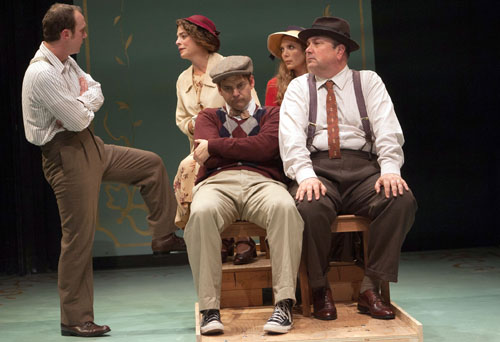
The publicity photo at the top is a moment from “The Happy Journey to Trenton and Camden” in which the family stops at a filling station along the way. Brian Tryborn is the station attendent, Stacy Ross in the back seat talking to him is the mother, Søren Oliver in the driver’s seat is the father, and Heather Gordon and Patrick Russell are the children. I love the expressions on the kids’ faces in this one, as the grownups chat pleasantly about nothing much.

“Absolutely Pointless”

I didn’t finish this Friday’s Listener crossword, “Absolutely Pointless” by Waterloo, until Monday — figuring out the last two clues and filling the last two cells in the grid during my midmorning break — despite having had Friday off work. Partly because I also had a lot of other things I wanted to get done on Friday, but partly just because it was a very tough puzzle.

The idea is that answers can be entered into the grid in any of the eight compass directions, not just across and down. What’s more, an answer can change direction one or more times. The answer can start in any direction, but whenever the letters N, NE, E, SE, S, SW, W, or NW occur in the word, corresponding to the points on a compass, those letters are not entered (making the grid “pointless”) and the rest of the word continues in that direction (which is usually but not necessarily a change in direction). For example, MOONWALK might be entered as

K
L M
A O
O

or perhaps as

K
L
A
M O O

The instructions, I thought, were much too terse, and I guess I should give a spoiler alert here in case you are working on the puzzle, because I’m about to write about what, as a former puzzle editor, I feel the instructions should have covered. No clue answers will be spilled or hinted at, however.

The very brief instructions left me with the first impression that entries were going to snake through the grid, possibly changing direction with every letter even where there wasn’t a compass direction to fix what that direction was. It wasn’t long before I saw that if that were true, the puzzle was unlikely to have a unique solution (not without a lot more clues), so I decided to solve with the tentative assumption that an entry couldn’t change direction except where it contained a compass direction, figuring that if that wasn’t the case I would bump up against an impossibility soon enough. I never hit a contradiction, so that was the right assumption to make, but there are probably any number of alternate “solutions” possible without that assumption, and as far as I can see they would be valid according to a not unreasonable interpretation of the instructions.

It would have been nice, too, if the instructions had mentioned that each entry contains at least one compass direction and may contain more than one, that not every compass direction causes a change in direction (when the entry is already heading in that direction), and that an entry may therefore change direction once, more than once, or not at all. These are less crucial pieces of information, as you eventually figure out in the solving that these things have to be true or no solution is possible. But it would have made the puzzle easier to get a handle on if they’d been spelled out.

Worst of all, the instructions did not mention that a single entry may go through the same letter in the grid more than once. BORNEO, for example, might be entered as

B
O
R

This was the omission that really annoyed me, because I figured the natural assumption would be that reusing the same letter is not OK, and that therefore they’d surely mention it if it was, and as a result I eventually reached a point where it was impossible to enter all the answers I’d gotten so far, and I had to scrap my first grid and start over with a fresh copy. Bah humbug. I like a tough puzzle, but I’m not so hot on making a puzzle tougher by making the solver guess at what its rules are. And this puzzle was tough enough as it was!

Other than the frustratingly uninformative instructions, though, I thought this was a fine puzzle. I’ve read some criticism online of the fact that it doesn’t end with any kind of surprise — no hidden phrase appearing in the completed grid, no quotation by Lewis Carroll being spelled out somewhere, that sort of thing. But I don’t see why every Listener puzzle needs to be like that. This was a good and enjoyable challenge, if a very tough one.